The Landlord’s Electrical Playbook, Part 4 of 6
HMO Electrical Requirements — What’s Different and What Gets Missed
By Frankie · April 2026 · 7 min read

Last month I carried out an EICR on a six-bedroom HMO in Tang Hall. The landlord had been told by his previous electrician that it was “basically the same as a normal rental”. It isn’t. The property had 26 circuits, shared cooking facilities on two floors, and a fire detection system that didn’t meet the licensing conditions. The report took twice as long as a standard rental, and the remedial list was substantial.
If you own or manage an HMO in York, the electrical requirements are meaningfully different from a single-occupancy rental. Here’s what actually changes and where I see landlords getting caught out.
Why HMOs Are Electrically Different
A standard two-bedroom rental typically has 8–12 circuits. A six-bedroom HMO can easily have 20–30. Each lettable room often has its own heating circuit, sometimes its own cooking appliance circuit, and the communal areas add lighting, fire detection, and shared kitchen circuits on top. More circuits means more testing, more time, and a higher EICR cost, there is no honest way around that.
The other difference is occupancy. Multiple unrelated tenants sharing a building creates fire risk that single-household properties simply don’t have. A fire in one room can cut off escape routes for tenants in others. That’s why the fire detection and electrical safety requirements go further than standard rentals.
Fire Detection: LD2 Grade D as the Minimum
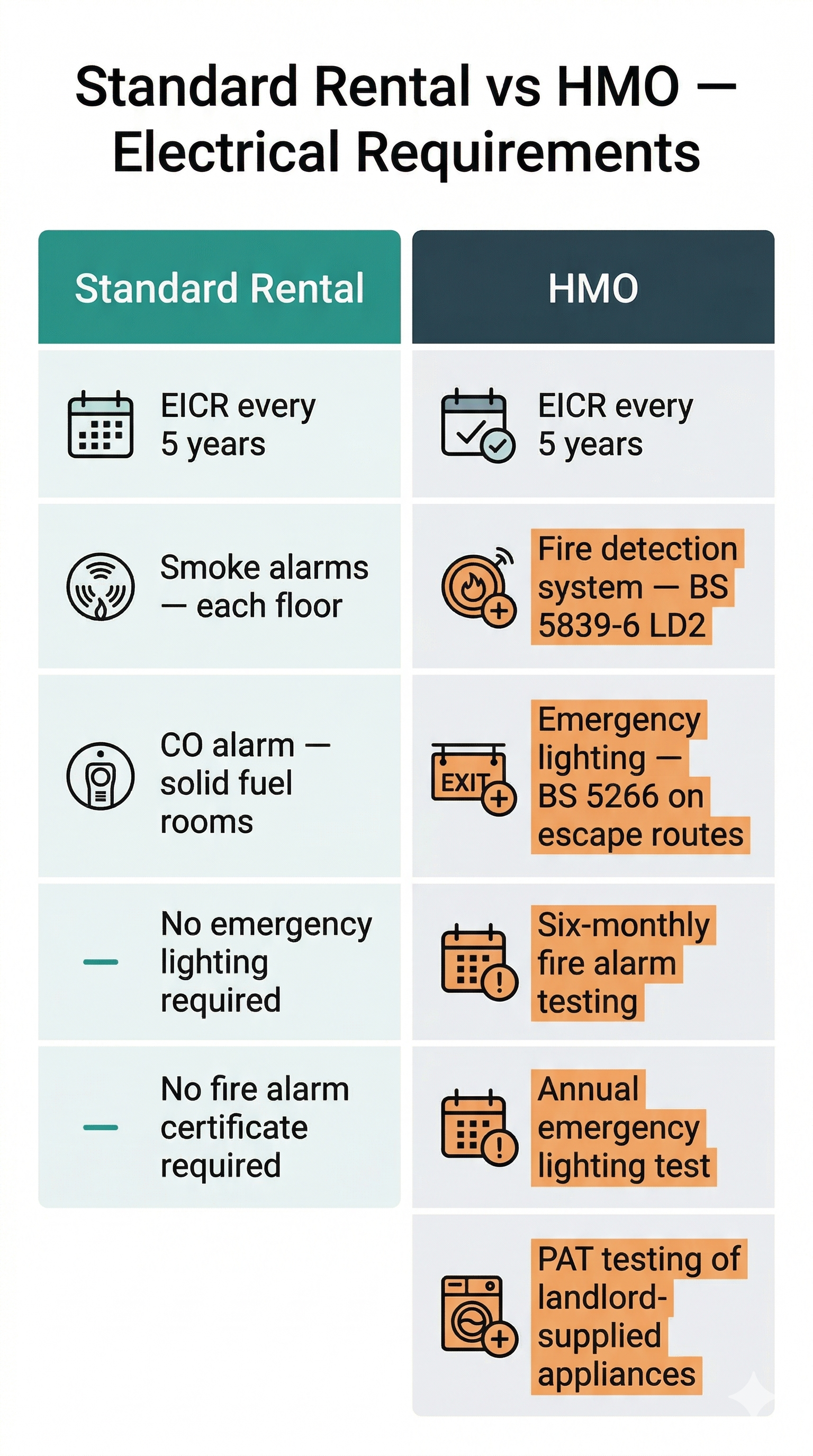
Most HMO licensing conditions require an LD2 Grade D fire detection system as a minimum. In plain terms, that means interlinked smoke alarms covering all escape routes (hallways, landings, stairwells), the room with the highest fire risk (usually the main kitchen), and heat detection in the kitchen itself. “Interlinked” means when one alarm activates, they all sound, so a tenant on the top floor hears the kitchen alarm immediately, not after smoke has filled the stairwell.
Grade D means mains-powered with battery backup. The standalone battery alarms that satisfy most standard rentals are not sufficient for an HMO. I find this is the single most common gap when I inspect HMOs in York, the landlord has fitted alarms, but they’re not interlinked, not mains-powered, or not covering the right rooms. On a property in South Bank last year, there were seven smoke alarms in the building, but none of them were connected to each other. Every one was a standalone unit. If the kitchen alarm had gone off at 3am, the two tenants on the second floor wouldn’t have heard it.
Shared vs Individual Consumer Units
In a standard HMO, a single shared consumer unit is the norm. That’s fine, provided every circuit is properly labelled so it’s clear which circuit serves which room. If a tenant in Room 3 needs the power isolated for maintenance, I need to know exactly which breakers to switch off without killing the supply to Rooms 1, 2, and 4. Mislabelled or unlabelled consumer units are a common finding on HMO EICRs, not a safety defect in itself, but a code that goes on the report and needs resolving.
Larger conversions, particularly where individual rooms have their own cooking and metering, sometimes have separate consumer units per unit. This makes isolation cleaner but adds complexity to the EICR, because each consumer unit is effectively a separate installation that needs full testing.
More Circuits Means a Longer EICR
I price EICRs by circuit count, not by bedroom count. For a standard rental with 10 circuits, the inspection and testing takes a set amount of time. For an HMO with 25 circuits, it takes proportionally longer. The report format is identical, same observations, same coding system, but the scope of testing is substantially larger. Landlords who budget for an HMO EICR based on standard rental prices consistently underestimate the cost.
A typical six-bedroom HMO EICR in York takes the better part of a full day. A standard two-bedroom rental takes half that. The difference isn’t complexity; it’s volume.
Common HMO Issues I Find on EICRs in York
After inspecting HMOs across Tang Hall, South Bank, and the Groves, the same problems come up repeatedly.
What I keep finding
Fire detection gaps. Alarms present but not interlinked, or missing from key escape routes. This fails the licensing conditions even if each individual alarm works perfectly.
Overloaded circuits. Rooms with electric panel heaters, kettles, and cooking rings all running from a single socket circuit. The circuit might not trip, but it’s running at or near capacity continuously.
Missing or incorrect circuit labelling. The consumer unit schedule either doesn’t exist, hasn’t been updated after alterations, or simply says “Room 1” when Room 1 is now split into Rooms 1a and 1b.
DIY extensions in communal areas. Additional sockets or lighting added without proper certification, often by previous landlords or tenants rather than a registered electrician.
Earth fault loop impedance outside limits. Older properties with original wiring serving extended circuits that have never been retested after modification.
HMO Licensing and Electrical Conditions
There are two types of HMO licensing that affect York landlords, and both have electrical safety conditions built in.
Mandatory licensing is national law. It applies to any property occupied by five or more tenants forming two or more separate households. If your property meets that definition, you must have a licence regardless of where in York it is. The licence conditions require a valid EICR (renewed every five years) and appropriate fire detection.
Additional licensing is a local power that City of York Council can use to extend licensing to smaller HMOs, those with three or four tenants, for example, in specific areas where there’s evidence of management problems. The electrical conditions are similar: valid EICR, adequate fire detection, and the installation must be in satisfactory condition.
In both cases, the EICR isn’t just a box to tick. If the report identifies code C1 or C2 observations, those need resolving before the licensing officer will be satisfied. I’ve written about what C1, C2, and C3 codes mean in practice separately, but for HMO landlords, the stakes are higher because a licensing breach can mean prosecution, not just a civil penalty.
What This Means Practically
If you’re a York landlord with an HMO, the electrical compliance requirements are not dramatically complicated, but they are more extensive than a standard rental, and the consequences of getting them wrong are more severe. The EICR takes longer and costs more. The fire detection standard is higher. The licensing conditions are specific and enforced.
The best approach is straightforward: get the EICR done by someone who understands HMO circuit layouts, make sure the fire detection meets LD2 Grade D minimum, and keep the consumer unit labelling accurate and current. If your property has had rooms added, split, or reconfigured since the last inspection, tell the electrician before the visit, it affects how the report is scoped on site.
For a fuller picture of EICR fines and enforcement, read the £40,000 fine and what triggers it. For smoke and CO alarm requirements specifically, see what you actually need fitted.
Frequently Asked Questions
Do HMOs need a different type of EICR?
The EICR itself is the same report format, but the scope is larger. An HMO typically has more circuits, individual room heaters, shared kitchen appliances, communal lighting, so the inspection takes longer and costs more than a standard rental property. The five-year validity period is the same.
What fire detection does an HMO need?
Most HMOs require an LD2 Grade D fire detection system as a minimum. This means interlinked smoke alarms in escape routes, landings, and the room where the fire risk is highest (usually the kitchen), plus heat detection in the kitchen itself. Some licensing conditions go further than this baseline.
Does each room in an HMO need its own consumer unit?
Not necessarily. Many HMOs operate from a single shared consumer unit, which is perfectly acceptable provided circuits are properly labelled and each tenant’s circuits are identifiable. Some larger conversions do have individual consumer units per room, especially where rooms have their own cooking facilities and metering.
How much does an EICR cost on an HMO?
More than a standard rental, because there are more circuits to test. A typical six-bedroom HMO in York might have 20–30 circuits compared to 8–12 in a standard rental. I price EICRs by circuit count, not by bedroom count, because that’s the only honest way to reflect the actual work involved.
What is the difference between mandatory and additional HMO licensing in York?
Mandatory licensing applies to properties with five or more tenants forming two or more households. This is national law. Additional licensing is a local scheme that councils can introduce for smaller HMOs. City of York Council has used additional licensing in specific areas. Both schemes require a valid EICR and appropriate fire detection as conditions of the licence.
Frankie Sewell
NICEIC Approved Contractor • YRLA Recognised Service Provider • Bright Sparks of York
Need an HMO EICR or fire detection upgrade in York?
I carry out HMO inspections and fire detection installations across York. I’ll scope the job properly so there are no surprises on cost or timescale.
The Landlord’s Electrical Playbook, Part 4 of 6 · All parts →