The Landlord’s Electrical Playbook, Part 3 of 6
What an EICR Can’t Tell You — The Limitations Most Landlords Don’t Know
By Frankie · April 2026 · 8 min read
A landlord in Haxby called me last year after a tenant reported a burning smell from a socket. The property had a satisfactory EICR, carried out eighteen months earlier by another electrician. The landlord’s first question was: “How did the EICR miss this?”
The answer is that it probably didn’t miss it, the fault likely developed after the inspection. But the conversation that followed revealed something more fundamental: the landlord assumed a satisfactory EICR meant every wire, every connection, and every component in the property had been tested and declared sound. That’s not what an EICR does. Understanding where the boundaries of the inspection lie is just as important as understanding the codes on the report.
What an EICR Does Test
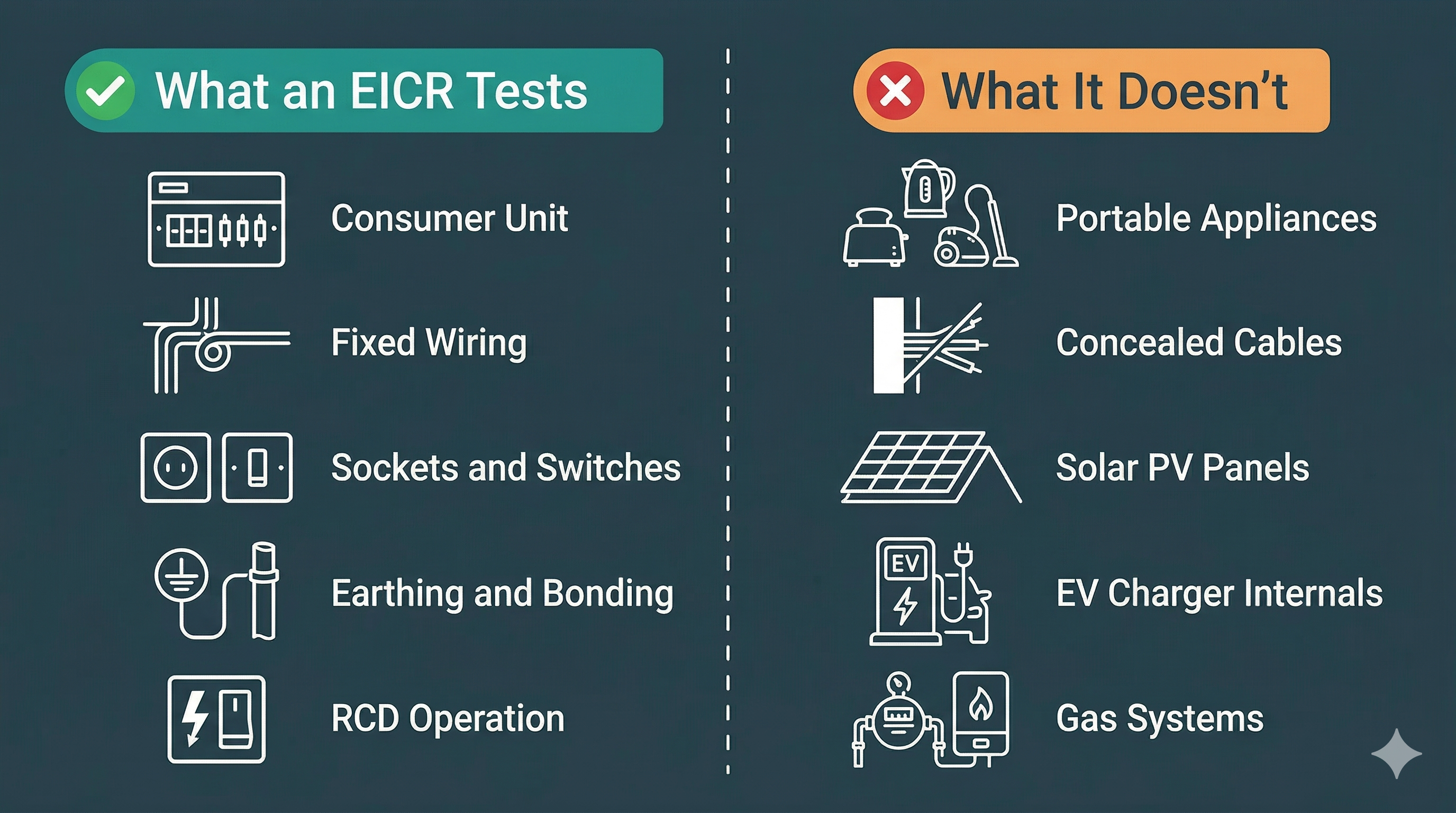
An EICR assesses the condition of the fixed electrical installation. That means the permanent wiring, the consumer unit (my guide to what a consumer unit does and when it needs upgrading explains the parts inside it), the protective devices (MCBs, RCDs, RCBOs), the sockets, switches, light fittings, and any fixed equipment that’s permanently connected, electric showers, cooker connections, immersion heaters, extractor fans.
The inspection involves a combination of visual checks and instrument testing. I visually inspect every accessible part of the installation for signs of damage, deterioration, or non-compliance. Then I carry out a series of electrical tests on each circuit: insulation resistance, earth fault loop impedance, earth continuity, polarity, and RCD operation. These tests reveal the condition of the wiring and the protective devices without needing to physically see every metre of cable.
That’s the key point. The tests are diagnostic, they measure the electrical characteristics of the circuits and use those measurements to assess whether the installation is safe. But they have limits.
What an EICR Does Not Test
Portable appliances. Anything that plugs into a socket is excluded. Kettles, washing machines, fridges, microwaves, electric heaters, lamps, none of these are part of the fixed installation and none are tested during an EICR. If you need appliance testing, that’s Portable Appliance Testing (PAT), which is a separate process entirely.
Cables concealed in walls, floors, and ceilings. I can test the electrical characteristics of a circuit from the consumer unit, and those tests will flag many types of concealed fault. But I cannot physically inspect a cable that’s plastered into a wall or buried under a concrete floor. If the insulation resistance readings are good and the earth continuity is sound, the circuit passes, even though I haven’t laid eyes on the cable itself. If a nail was driven through a cable six months after the EICR and hasn’t yet caused a measurable fault, the next EICR won’t find it until the insulation breaks down enough to show in the readings.
Bonding behind baths and showers without access. Supplementary bonding in bathrooms, the earth connections between exposed metalwork, needs to be visually verified. If the bath panel is sealed, tiled over, or otherwise inaccessible, I can’t confirm the bonding is in place without removing it. In those cases, I record the limitation on the report. This is common in rental properties across York where bathroom refurbishments have been carried out without electrical involvement.
The DC side of solar PV installations. If the property has solar panels, an EICR covers the AC side, the inverter output, the connection to the consumer unit, and the generation meter wiring. The DC side (the panels on the roof, the DC cabling from the panels to the inverter, and the DC isolator) requires specialist testing. This is a growing issue in York as more rental properties have solar PV fitted, and landlords assume the EICR covers the whole system. It doesn’t.
EV charger internal components. If the property has a dedicated EV charger, and my guide covers how an EV charger is wired in and what it needs from the supply, the EICR covers the supply circuit to the charger, the cable from the consumer unit to the charger unit, the protective device, and the earth. The charger’s internal electronics and safety systems are not part of the fixed wiring test. Charger manufacturers typically recommend their own periodic servicing.

The “Extent and Limitations” Section
Every EICR has a section, usually on the first or second page, titled “Extent and Limitations of the Inspection”. This is the section most people skip, and it’s the one that matters most for understanding what the report actually covers.
This section records two things. First, the agreed extent of the inspection, which parts of the installation were included and which were excluded. Second, any limitations encountered during the inspection, areas that couldn’t be accessed, circuits that couldn’t be isolated, or components that couldn’t be tested for practical reasons.
Common limitations I record on York properties include: loft spaces with insufficient safe access (no boarding, no fixed lighting, restricted headroom), sealed bath panels preventing visual inspection of bonding, circuits that couldn’t be tested because the tenant had equipment that couldn’t be disconnected, and areas behind fixed kitchen units where junction boxes or cable routes were concealed.
If the extent and limitations section is blank or contains only generic boilerplate text, that’s a red flag. A thorough inspection should always identify at least some limitations, no domestic property gives the electrician perfect access to every part of the installation. If the report says there were no limitations at all, the electrician either didn’t look hard enough or didn’t record what they found.
Why “Satisfactory” Doesn’t Mean “Perfect”
A satisfactory EICR means: based on the inspection and tests carried out, within the stated extent and limitations, the fixed electrical installation is safe for continued use and no C1 or C2 defects were identified.
It does not mean: every single wire, connection, terminal, and component in the property is in perfect condition and will remain so for the next five years.
Electrical installations are not static. Connections loosen over time due to thermal cycling. Insulation degrades with age and heat exposure. Rodents chew cables in loft spaces. Tenants overload circuits with extension leads. Plumbers and kitchen fitters disturb wiring during refurbishments. A satisfactory EICR is a snapshot of the installation’s condition at the time of inspection, not a guarantee for the future.
This is why the regulations require EICRs every five years rather than once, electrical installations deteriorate, and periodic re-testing catches problems before they become dangerous.
Common Surprises
These are the situations I see regularly in York where landlords are caught off guard by the limitations of an EICR.
The socket that passed the test but still failed. A socket can pass every electrical test on an EICR and still develop a loose terminal six months later. The terminal was tight when I tested it. Over time, with repeated plug insertion and removal, thermal cycling, and the natural creep of metal under pressure, it works loose. The EICR couldn’t predict that.
The bathroom bonding that wasn’t there. I recorded a limitation on an EICR because the bath panel was sealed and I couldn’t verify supplementary bonding. The landlord didn’t follow up. Eighteen months later, a plumber replaced the bath and confirmed there was no bonding at all. The EICR didn’t miss it, it explicitly flagged that it couldn’t verify it. The information was in the report; it just wasn’t acted on.
The extension lead fire. A tenant daisy-chained three extension leads to run a heater, a dehumidifier, and a tumble dryer from a single socket. The socket circuit passed the EICR. The appliances and extension leads are outside the scope of the fixed installation. The overload happened in the plug-in equipment, not in the wiring.
When You Need Additional Testing
An EICR is the baseline, but there are situations where additional testing is necessary.
FI codes on the report. If the EICR flags Further Investigation items, those need to be resolved, either by gaining access to the areas that couldn’t be inspected, or by carrying out more detailed fault-finding on circuits with borderline readings.
Intermittent faults. If tenants are reporting tripping circuits, flickering lights, or occasional burning smells, and the EICR didn’t identify a cause, you likely need dedicated fault-finding. An EICR tests circuits under controlled conditions. Intermittent faults often only manifest under specific loads or temperatures that aren’t replicated during the standard test sequence.
After any significant work on the property. If a kitchen has been refitted, a bathroom has been replumbed, or an extension has been built since the last EICR, the existing report doesn’t cover the impact of that work on the electrical installation. Builders and plumbers regularly disturb wiring without realising it. A follow-up inspection of the affected circuits is the only way to confirm everything is still safe.
Specialist installations. Solar PV, battery storage systems, three-phase supplies, and commercial catering equipment all require testing beyond the scope of a standard domestic EICR. If your rental property has any of these, make sure the testing regime covers them specifically.
Frankie Sewell
NICEIC Approved Contractor • YRLA Recognised Service Provider • Bright Sparks of York
Need an EICR or fault-finding in York?
I carry out thorough EICRs with clear reporting of all limitations and findings. If you need dedicated fault-finding or a second opinion on an existing report, get in touch.
Questions
Does an EICR test electrical appliances?
No. An EICR covers the fixed electrical installation only, the wiring, consumer unit, sockets, switches, light fittings, and fixed equipment like electric showers and cooker connections. Portable and plug-in appliances (kettles, washing machines, fridges, etc.) are not tested. For appliance testing, you need Portable Appliance Testing (PAT), which is a separate process.
What does 'extent and limitations' mean on an EICR?
Every EICR includes a section stating the extent of the inspection and any limitations encountered. This records what was tested and, crucially, what was not tested, for example, circuits that couldn't be isolated, areas with restricted access (behind fitted kitchens, under fixed flooring), or parts of the installation that were excluded by agreement. Always read this section. It tells you what the report doesn't cover.
When do I need additional testing beyond an EICR?
You may need additional testing if the EICR records FI (further investigation) codes, if you're experiencing intermittent electrical faults not explained by the report, if you have specialist installations (solar PV, EV chargers, three-phase supplies) that need dedicated testing, or if the report notes significant limitations due to restricted access. In these cases, fault-finding or specialist testing is a separate service.
Does an EICR check cables inside walls?
Not directly. An EICR tests the electrical characteristics of circuits (insulation resistance, earth continuity, polarity, etc.), which can reveal problems with concealed cables. But it cannot physically inspect cables buried in walls or under floors. If test results suggest a concealed fault, the electrician will record an FI (further investigation) code, which may require opening up the fabric of the building to trace the problem.
Does an EICR cover solar panel wiring?
Partially. The AC circuits provided for a solar PV system are within the scope of an EICR, and the report also checks that the installation is properly arranged for having a second source of supply. The PV equipment itself sits outside a standard EICR and needs a separate inspection by someone qualified for it. The same goes for battery storage.
Does a satisfactory EICR mean my electrics are perfect?
No. A satisfactory EICR means the fixed electrical installation is safe for continued use based on what was tested and inspected. It doesn't mean every cable, connection, and component is in perfect condition, only that no C1 or C2 defects were found within the scope of the inspection. There may still be C3 (improvement recommended) items, and there may be areas that couldn't be fully assessed.
The Landlord’s Electrical Playbook, Part 3 of 6 · All parts →