Selling Your House: Electrical Certificates You Need (2026)

I get this call more often than you would think. Frankie, we are selling the house. The solicitor is asking about the electrics. What do we need?
It usually lands at the worst time. Offer accepted, three weeks from exchange, and suddenly there is a question mark over the wiring. This guide is the answer I give on the phone, expanded into a proper walk-through of what solicitors, buyers and surveyors look for in 2026, and how to be ready for it.
Do you legally need an EICR to sell your house?
No. If you own and live in the property, there is no legal requirement to provide an Electrical Installation Condition Report when you sell. Rented property is a different story. Private landlords in England have been required to have a valid five-year EICR since 1 April 2021 under the Electrical Safety Standards in the Private Rented Sector (England) Regulations 2020 [2]. For owner-occupiers, it is expectation, not law.
The catch is that buyers and their solicitors routinely ask for an EICR anyway. Think of it the way you would an MOT when selling a car. Not mandatory, but a sale without one tends to stall at the worst possible moment.
What the TA6 form asks about electrics
When you instruct a conveyancing solicitor, one of the first things they send you is the TA6 Property Information Form, the Law Society document every UK home seller completes [1]. Two sections touch on electrics:
- Section 11, Services. Asks when the electrical installation was last checked and tested, and whether a report is available.
- Section 12, Alterations, planning and building control. Asks whether any electrical work has been done, by whom, when, and whether certification and Building Regulations approval are available.
You have to answer these honestly, and the buyer's solicitor will want to see supporting paperwork for any yes
answer. A blank Section 12 with work done, no paperwork
is the single most common reason a sale slows down at conveyancing.
The three certificates to gather
1. Electrical Installation Certificate (EIC)
Issued by an electrician whenever a new installation or a significant alteration is completed. Think rewires, new circuits, consumer unit replacements, new bathroom wiring. It is the document that proves the work complies with BS 7671:2018+A4:2026 [3]. Every EIC has a serial number, the electrician's name and qualification, and details of the test results.
2. Part P Building Regulations compliance certificate
Issued by the local authority or the electrician's Competent Person Scheme (such as NICEIC or NAPIT) for any notifiable electrical work done since 1 January 2005. If the electrician was scheme-registered, the scheme notifies Building Control for you and you get this certificate in the post a few weeks after the work [4]. Without it, the work is technically unregistered even if it was done properly.
3. Electrical Installation Condition Report (EICR)
A condition survey of the whole installation, issued after an electrician inspects and tests every circuit. Unlike an EIC, the EICR reports on what is already there, not work just completed. A satisfactory EICR less than five years old is what the buyer's solicitor hopes to see in the conveyancing pack.

Document checklist, what to have in the pack
| Document | Who issues it | When you need it |
|---|---|---|
| Electrical Installation Certificate (EIC) | Electrician who did the work | Any significant new installation since 1 January 2005 |
| Minor Electrical Installation Works Certificate (MEIWC) | Electrician who did the work | Smaller alterations, e.g. a new socket or circuit extension |
| Part P Building Regulations compliance certificate | Local authority or Competent Person Scheme | All notifiable work since 1 January 2005 |
| Electrical Installation Condition Report (EICR) | Inspecting electrician | Pre-sale overall condition check, ideally less than five years old |
| Remedial works invoice and certificate | Electrician who did the remedial | If the EICR was unsatisfactory and you fixed the issues |
| Solar PV MCS certificate | MCS-registered installer | If the property has solar panels |
| EV charger install certificate and DNO notification | EV-charger installer | If the property has a home EV charger |
No paperwork? Here is the fallback
If you have lost certificates, or the work was done by a previous owner, you still have options:
- Ask the original electrician for a duplicate. Most registered electricians keep records for at least six years.
- Contact Building Control at your local authority for copies of any Part P compliance certificates they issued.
- Commission a fresh EICR to establish the current condition of the installation. A satisfactory EICR covers a lot of historical worry.
- Take out indemnity insurance for the missing certificate. A one-off premium, paid at conveyancing, protects the buyer against enforcement action. It does not fix bad wiring, so it works best combined with a fresh EICR.
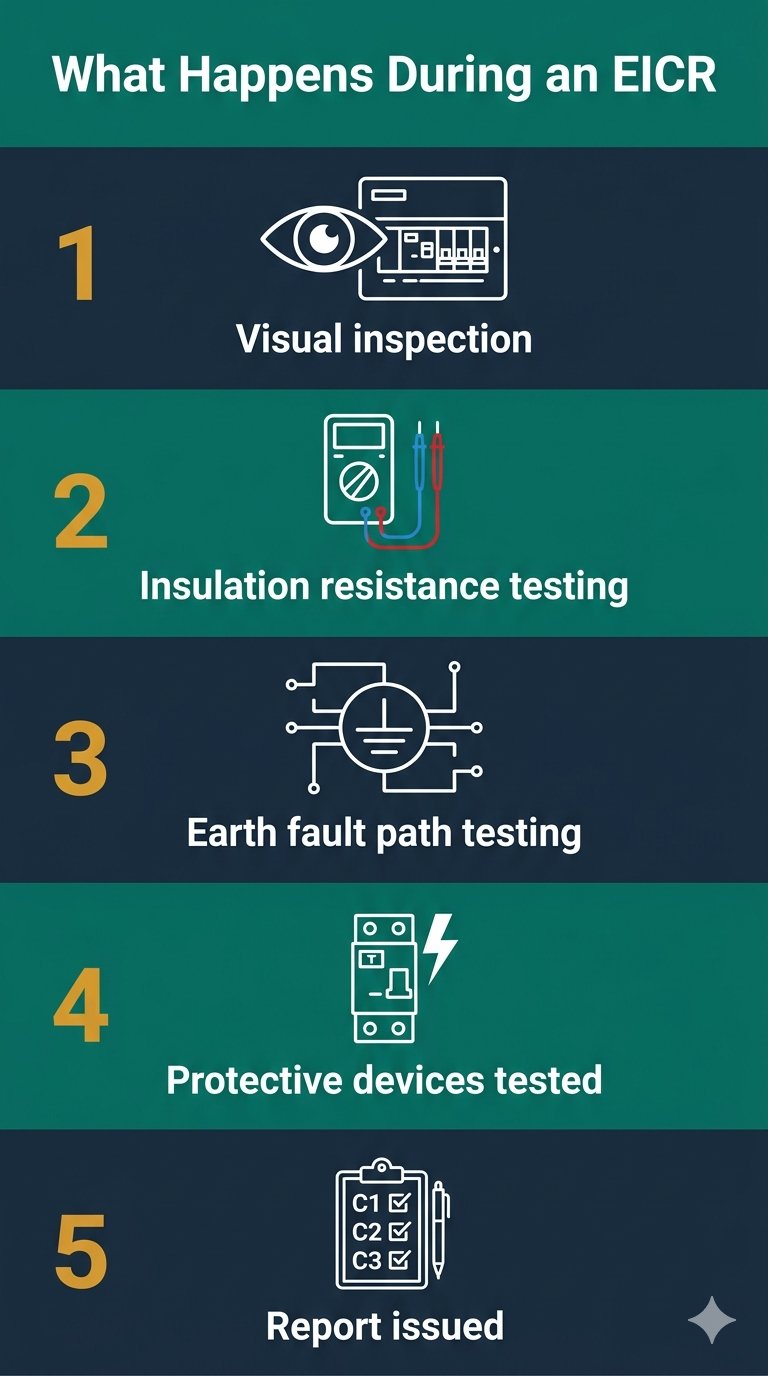
What an EICR tests on the day
An EICR is a hands-on, meter-in-hand survey of every circuit in the property. On a typical three-bedroom house it is a half-day job. The inspecting electrician checks:
- Insulation resistance on every circuit (live-to-earth and live-to-neutral)
- Earth continuity on every final circuit and every metallic part that should be bonded
- Polarity at every accessory
- RCD and RCBO operation and trip times at 30 mA and 150 mA
- Ze and Zs loop impedance readings at the intake and at the farthest point of each circuit
- Visible condition of the consumer unit, the cabling, and each accessory
The C1, C2, C3 grading system
Every issue flagged on an EICR gets a code. The codes decide whether the overall report is satisfactory or unsatisfactory. If you only take one thing away from this article, take this:
| Code | Meaning | Effect on the report | What to do |
|---|---|---|---|
| C1 | Danger present, risk of injury | Unsatisfactory | Make safe immediately. Often done on the day. |
| C2 | Potentially dangerous, remedial required | Unsatisfactory | Plan remedial work before completion, or disclose to buyer. |
| C3 | Improvement recommended, not urgent | Satisfactory | Optional. Often left for the buyer to decide. |
| FI | Further investigation required | Unsatisfactory until cleared | Needs a return visit to complete testing. |
A report can have a stack of C3s and still be satisfactory. One C1 or one C2, and it is unsatisfactory. That single word is what the buyer's solicitor reads.
Common pre-sale electrical issues
Six issues account for the majority of C1 and C2 codes I see on York pre-sale EICRs:
| Finding | Typical code | Typical remedy |
|---|---|---|
| No RCD protection on socket circuits | C2 | Consumer unit upgrade or add RCBOs |
| Plastic consumer unit in a flat or HMO | C2 | Replace with metal enclosure to BS 7671 amendment 3 (2015) onwards |
| Cracked or loose accessory on an outdoor or bathroom circuit | C2 | Replace accessory, retest circuit |
| Rubber-insulated (pre-1960s) cable still in use | C2 | Rewire affected circuits or whole property |
| Main earth or main bonding undersized or missing | C2 | Install or upgrade main earth and bonding |
| Missing circuit labelling or schedule on the CU | C3 | Label and update schedule |
Pre-sale electrical checklist, eight steps
This is the same checklist I run clients through on the phone. Work through it in order, starting as early as you can:
- Gather existing certificatesFind every EIC, MEIWC, Part P certificate and previous EICR for the property. Check the kitchen drawer, the consumer unit cupboard, and the solicitor's file from when you bought the house.
- Fill any missing paperworkFor certificates you cannot find, contact the original electrician for duplicates, or ask local authority Building Control for copies of the Part P certificates they issued.
- Book an EICR eight to twelve weeks before exchangeA pre-sale EICR on a satisfactory installation is your single strongest document. Book it early enough that any remedial work can be done on your timetable.
- Read the EICR when it arrivesCheck for any C1 or C2 items and the overall satisfactory or unsatisfactory outcome. C1 items should be made safe the same day. C2 items need a plan before completion.
- Estimate and schedule any remedial workAsk the inspecting electrician for a written estimate of the remedial work. Decide whether to do the work yourself or pass it to the buyer as a price reduction.
- Answer TA6 Section 12 accuratelyDisclose every piece of electrical work, dates, installer and certification on the TA6 Property Information Form. Attach scans of each certificate.
- Put everything in one PDF for the solicitorCombine the EICR, all EICs, Part P certificates, and any remedial work invoices into a single indexed PDF. This is the pack the buyer's solicitor asks for.
- Leave a folder for the new owner on moving dayLabelled plainly, in the consumer unit cupboard. A small courtesy that often ends in a kind Google review a week later.
Timeline: when to start
- 12 weeks before exchangeGather existing certificates. Contact Building Control if anything is missing.
- 8 weeks before exchangeBook and complete the pre-sale EICR.
- 6 weeks before exchangeEstimate any remedial work. Decide: do it, or pass as a price reduction.
- 4 weeks before exchangeRemedial work completed and signed off.
- 2 weeks before exchangeConveyancing pack submitted. TA6 answered, certificates attached.
- Moving dayLeave the folder for the new owner.
A note on cost
Every EICR and every remedial job is scoped on the property. Circuit count, consumer unit type, the age of the wiring, and how much of the loft and under-floor I can access all change the time on site. I give you a clear written estimate before any work starts, and we never bill for extras I have not first talked through with you. Book a pre-sale EICR in York.

I run pre-sale EICRs on York houses every week, from 1930s terraces near the racecourse to new-builds in Huntington. Every report comes with plain-English notes next to the codes, not just the standard BS 7671 phrasing, so you and your solicitor know exactly what the buyer will be asking about. More about me.
Selling soon? Let’s get your electrics sorted.
Tell me what you need and I will tell you what it involves. No obligation, no jargon.
Frequently asked questions
Do I legally need an EICR to sell my house?
No. If you own and live in the property there is no legal requirement to provide an Electrical Installation Condition Report when you sell. However, buyers and their solicitors routinely ask for one as part of conveyancing, and not having one can cause delays or price renegotiation.
What electrical certificates do I need to sell my house?
For any notifiable electrical work done since 1 January 2005 you need either the Part P Building Regulations compliance certificate issued by the local authority or the electrician’s Electrical Installation Certificate (EIC). For a general picture of the condition of the wiring you also want a current EICR. Any Minor Electrical Installation Works Certificates (MEIWCs) for smaller jobs should be in the pack too.
What is the TA6 form and what does it ask about electrics?
The TA6 Property Information Form is the Law Society questionnaire the seller completes for conveyancing. Section 12 covers alterations, planning and building control. It asks whether any electrical work has been done, when, by whom, and whether certification is available. Section 11 covers services and asks about the installation and its condition.
What if I have lost the certificates?
Ask the original electrician for a duplicate, or ask the local authority Building Control department for a copy of the Part P compliance certificate they issued. If neither is possible, a fresh EICR can confirm the current condition of the installation, and an indemnity insurance policy can cover the lack of paperwork for older work.
What happens if my EICR comes back unsatisfactory?
An unsatisfactory report lists issues graded C1 (danger present, immediate action required), C2 (potentially dangerous, remedial work recommended before reuse), or C3 (improvement recommended but not urgent). You can still sell, but the buyer may use the report to renegotiate the price or ask you to carry out the remedial work before exchange.
Should I get an EICR before putting my house on the market?
Yes. Getting the EICR before you list gives you control of the timeline. If the report is satisfactory you can hand it to your estate agent as a selling point. If something needs fixing, you deal with it on your terms instead of scrambling three weeks before exchange.
How recent does my EICR need to be for a sale?
There is no legal rule for an owner-occupier sale, but solicitors and buyers look for a report less than five years old for a domestic property. If your EICR is older than that, it is worth having it redone before listing.
Can I sell my house with an old fuse-wire consumer unit?
Yes, you can. It is not illegal to own a pre-BS 7671 fuse board. It will show up on an EICR and is likely to be graded C2 or C3, which the buyer may use in the negotiation. You can replace the board, or disclose it honestly and expect the price conversation.
My buyer’s survey flagged the electrics. What now?
Homebuyer surveys often flag electrics generically because the surveyor is not a qualified electrician. An EICR replaces the vague concern with a specific report. If the EICR is satisfactory, the sale can proceed. If it lists issues, you have a clear scope of work to estimate and decide whether to do before completion or pass as a reduction.
When should I book the pre-sale EICR?
Ideally eight to twelve weeks before you expect to exchange. That leaves time for the report to come back, for any remedial work to be estimated and done, and for the paperwork to be in the conveyancing pack when the solicitor asks.
References
- The Law Society, TA6 Property Information Form (4th edition). lawsociety.org.uk
- Electrical Safety Standards in the Private Rented Sector (England) Regulations 2020, SI 2020/312. legislation.gov.uk/uksi/2020/312
- BS 7671:2018+A4:2026, IET Wiring Regulations, 18th Edition, in force from 15 April 2026. British Standards Institution. bsigroup.com
- The Building Regulations 2010, Approved Document P (Electrical safety, dwellings). gov.uk/government/publications/electrical-safety-approved-document-p
- RICS Home Survey Standard, April 2021, Royal Institution of Chartered Surveyors. rics.org