Consumer Unit Upgrade Guide 2026: Signs, Process & Regs
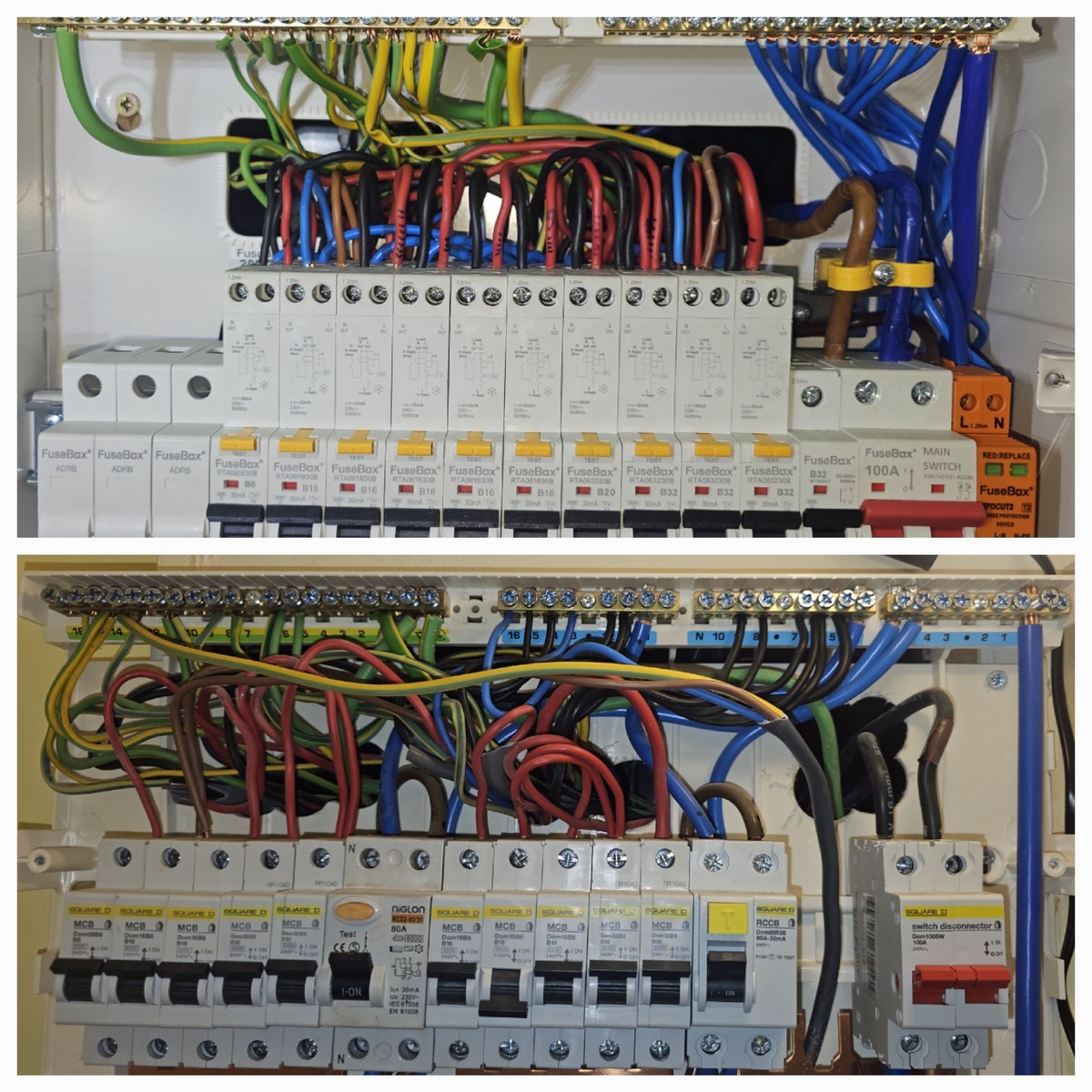
Your consumer unit, the board most people call the fuse box, is the heart of the electrics in your home. It takes the incoming supply and distributes it to every circuit in the property, with a protective device on each. If the board is old or lacks modern protection, everything downstream is running without a safety net. This guide covers how to tell if yours needs replacing, what a modern board includes under BS 7671:2018+A4:2026, and what happens on the day.
What a consumer unit actually does
Your consumer unit is the single point where the supply from the meter is split into the final circuits that feed the lighting, sockets, cooker, shower, boiler and outbuildings. Every circuit passes through a protective device that disconnects the circuit automatically if something goes wrong. The history of those protective devices tells you a lot about what you have:
- Rewireable fuses (the great-grandparent). A piece of fuse wire that melts when too much current flows. Protects the wiring from overheating. Does not protect you from electric shock.
- MCBs, miniature circuit breakers (the grandparent). Rocker switches that trip automatically and reset with a flick. Still only overcurrent protection.
- RCDs, residual current devices (the parent). Detect tiny imbalances in current caused by leakage to earth, and cut the power in under 30 milliseconds. This is what protects people from electric shock.
- RCBOs, combined protection (current standard). Overcurrent protection and residual current protection in one device per circuit. A fault only trips the affected circuit.
- AFDDs, arc fault detection (current amendment). Detect the signature of arcing faults, a leading cause of electrical fires. Required on specific circuits under BS 7671:2018+A4:2026 in HMOs, student accommodation and care homes.
For more on the difference, see fuse box vs consumer unit and MCB vs RCD vs RCBO vs AFDD.
Signs your fuse box needs replacing
- Wooden backboard. Pre-1990s installation with exposed timber behind the board.
- Rewireable fuse carriers. Round or rectangular pull-out holders with fuse wire inside, rather than rocker switches.
- No RCD protection. Modern boards have a switch labelled RCD or RCCB, or an RCBO on every circuit. If yours has none of these, the socket and lighting circuits have no shock protection.
- Split-load board with one side unprotected. Looks modern but only half the circuits pass through the RCD. Almost always a C2 on an EICR.
- Frequent tripping. Whole-house trips or a single circuit that trips repeatedly, especially from multiple circuits at once, often points at cumulative leakage on a shared RCD.
- Burn marks or discolouration. Scorch marks, warm spots, melted plastic around a terminal or device.
- Age. Any board older than 25 to 30 years is unlikely to meet current regulations.
What a modern consumer unit includes
- Steel enclosure. Non-combustible, mandatory for domestic installations since January 2016.
- 100 A main switch. Double-pole isolator at the origin of the final circuits.
- One RCBO per final circuit. Combined overcurrent and 30 mA residual current protection. A fault on one circuit only trips that circuit.
- Type 2 Surge Protection Device (SPD). Protects downstream equipment from voltage transients from lightning or grid events. A default expectation under BS 7671:2018+A4:2026 in most domestic premises.
- Arc Fault Detection Devices (AFDDs) on specified circuits. Required in HMOs, student accommodation and care homes under A4:2026. Recommended elsewhere.
- 25 mm tails and a 16 mm main earth. Current expectation for a 100 A single-phase supply.
- 10 mm main bonding. Green-and-yellow bonding clamped to gas and water service pipes within 600 mm of entry.
- Printed schedule of circuits. Fixed inside the cover, every circuit identified by function, device rating and reference method.
Old vs modern board, side by side
| Feature | Typical pre-2000 board | Modern board |
|---|---|---|
| Enclosure | Plastic or wood | Steel, non-combustible |
| Overcurrent protection | Fuse wire or MCBs | RCBO per circuit |
| Residual current (shock) protection | None or partial | 30 mA per circuit via RCBO |
| Surge protection (SPD) | None | Type 2 at origin |
| Arc fault detection (AFDD) | None | On specified circuits |
| Nuisance trip behaviour | Whole group trips | Single circuit trips |
| EICR risk | Frequent C2 | Usually satisfactory |
| Ready for EV, heat pump, solar | No | Yes, with correct RCD type |
What BS 7671:2018+A4:2026 expects
The 4th amendment to the 18th Edition of the IET Wiring Regulations came into force on 15 April 2026 [1]. For a new or replacement consumer unit in a UK dwelling, the headline expectations are:
- 30 mA RCD protection on all socket outlets rated up to 32 A and all final circuits supplying lighting.
- Type A as the minimum RCD type for new circuits.
- Type B RCD or 6 mA DC sensing built into any EV charging circuit.
- Type 2 Surge Protection Device at the origin in most domestic premises.
- AFDDs on socket circuits in high rise residential buildings, HMOs, purpose-built student accommodation and care homes. For every other property, including an ordinary house, they are recommended rather than required.
- A non-combustible enclosure. Steel is the usual answer, and the regulation names ferrous metal as an example of a non-combustible material.
- Main bonding to gas and water service pipes at 10 mm minimum.
A compliant replacement therefore means more than just swapping the box: tails, earthing, bonding and the RCD/RCBO/AFDD specification all have to be right for the property type.
What makes a consumer unit "18th edition" compliant?
This is the phrase most people search for, so it is worth untangling. The 18th Edition is the current edition of BS 7671, and A4:2026 is its fourth amendment. When someone asks for an "18th edition consumer unit" or an "18th edition fuseboard", what they almost always mean is a board built to the list above: a non-combustible enclosure, RCD protection on the circuits that need it, surge protection, and AFDDs where the property type calls for them.
One thing worth knowing, because it surprises people. The metal enclosure everyone associates with the 18th Edition is older than the 18th Edition. It arrived with Amendment 3 to the 17th Edition in January 2016 and was carried forward, which is why boards fitted from 2016 onward already look the part [unverified: the Amendment 3 attribution is from secondary sources, not read from the standard].
There is also no such thing as a consumer unit that is compliant on its own. Compliance is a property of the installation, not the box. A perfect board fed by undersized tails, or protecting cables in poor condition, is not a compliant installation. That is why I survey before quoting rather than pricing a board off a photograph.
Why the existing wiring condition matters
A new consumer unit has to work safely with the circuits feeding out of it. Older installations often have legacy quirks that a shared RCD forgave but an RCBO does not. Two common ones:
- Borrowed neutrals. Two circuits sharing a neutral wire. A modern RCBO sees the shared neutral as a fault and trips the moment the circuit is energised. The fix is to separate the neutrals, which can mean opening up walls or running a new cable.
- High insulation resistance loss. Older rubber or early PVC insulation degrades and leaks small currents to earth. An RCBO with 30 mA residual sensitivity trips on circuits that used to run fine.
An EICR before the upgrade catches both. I can carry out the EICR and the replacement on the same visit, or split the two if remedial work is likely.
What happens on the day
- Pre-visit surveyI look at the existing board, tails, main earth and main bonding, count circuits, check rooms each one feeds, and confirm access.
- Supply isolationOn the day the supply is isolated at the meter or at the DNO cutout. The house is without power for the middle of the day, usually four to six hours.
- Remove the old boardThe existing consumer unit is disconnected, labelled and removed. Undersized or damaged tails are replaced. Missing main bonding is installed.
- Fit and wire the new boardThe new steel enclosure is mounted, the main switch, RCBOs and SPD are clipped into the busbar, and each circuit is landed, labelled and torqued to the manufacturer’s spec.
- Test and certifyInsulation resistance, earth fault loop impedance, polarity, RCD trip times and continuity are measured on every circuit. Results go on an Electrical Installation Certificate.
- Re-energise and hand overSupply back on, lights and sockets checked through with you, printed schedule fixed inside the cover, notifiable work registered with Building Control via NICEIC.
A fuller day-by-day walkthrough: Consumer Unit Upgrade, What to Expect on the Day.
Future-proofing for EV, heat pump, solar
Upgrading the board is a good moment to think about what you might connect to it in the next few years. Three things are worth mentioning during the survey:
- EV charger. A dedicated 7 kW charger circuit needs a Type B RCD or a charger with 6 mA DC sensing. Better to lay out the board for it now than retrofit later.
- Heat pump. Draws significant sustained current and usually wants its own circuit. Leave a spare way and adequate main fuse headroom.
- Solar PV and battery. Needs Type B RCD protection on the generation side, and often an additional isolator near the inverter.
A note on cost
Every consumer unit replacement is scoped on a site visit. Cost depends on circuit count, enclosure type, tails and earthing condition, whether AFDDs or Type B RCDs are needed, whether any cabling needs making good, and access. I give you a clear written estimate before any work starts. Book a consumer unit survey.

I replace consumer units across York every week, from Victorian terraces to new-build estates. Every job leaves with the EIC in your hand, the schedule printed inside the cover, and the notifiable work registered with NICEIC the same day. More about me.
Think your fuse box needs replacing?
I'll take a look, tell you where you stand, and give you a written estimate. If it does not need replacing, I'll tell you that too.
Frequently asked questions
What is a consumer unit?
A consumer unit is the modern name for a fuse box. It distributes electricity to every circuit in a property and contains the protective devices (MCBs, RCDs, RCBOs, AFDDs) that disconnect a circuit automatically if something goes wrong. A modern UK consumer unit meets BS 7671:2018+A4:2026.
How do I know if my fuse box needs replacing?
Signs include a wooden backboard, rewireable fuse carriers rather than rocker switches, no RCD protection on socket and lighting circuits, frequent tripping, burn marks or discolouration around devices, or an enclosure feeling warm. Age alone matters too: boards older than 25 to 30 years rarely meet current standards.
Do I legally have to replace my fuse box?
No. There is no blanket legal requirement to replace a working fuse box. However, notifiable electrical work done after an old board must bring the installation up to current BS 7671:2018+A4:2026, which in practice means replacing the board. Rental properties that fail an EICR often need a replacement to resolve C2 findings within the 28-day window.
What is an RCBO and why does it matter?
An RCBO combines overcurrent protection (MCB function) and residual current protection (RCD function) in a single device on one circuit. The advantage over a split-load board is that a fault only trips the affected circuit, not half the house. BS 7671:2018+A4:2026 treats RCBO-per-circuit as the preferred layout.
What is an AFDD and do I need one?
An AFDD (Arc Fault Detection Device) detects the signature of an arcing connection, a leading cause of electrical fires. Under BS 7671:2018+A4:2026 AFDDs are required on socket circuits rated up to 32 A in higher-risk dwellings, including HMOs, student accommodation and care homes. In other domestic premises they are recommended, not mandatory.
How long does a consumer unit upgrade take?
Most domestic upgrades are a one-day job. The supply is off for most of the working day, typically four to six hours. Larger properties, full rewires, or jobs where cabling needs making good can run to two days.
Do I need an EICR before a consumer unit upgrade?
Not always, but it helps. An EICR tests the wiring before the new board goes in, which catches shared neutrals and other legacy issues that would trip a new RCBO as soon as it was energised. Many upgrades combine the EICR and the board replacement in the same visit.
Does the new consumer unit have to be metal?
Yes. Since January 2016, new consumer units installed in domestic dwellings must have a non-combustible enclosure, in practice a steel one. Plastic boards installed before that date are not illegal, but a replacement fitted today must be metal.
Will I lose power for the day?
You will lose power for most of the working day. We isolate the supply at the start, swap the board, test every circuit, and re-energise. Fridges and freezers usually survive a four to six hour off period with the doors closed. For longer jobs we agree any contingency (portable power, tenant liaison) in advance.
How do I get a quote for a consumer unit upgrade?
I scope every board on a site visit, because the cost depends on circuit count, tails and earthing condition, enclosure position, whether AFDDs or Type B RCDs are required for EV charging, and access. Contact me for a no-obligation survey and written estimate.
References
- BS 7671:2018+A4:2026, IET Wiring Regulations, 18th Edition, in force from 15 April 2026. British Standards Institution. bsigroup.com
- The Building Regulations 2010, Approved Document P (Electrical safety, dwellings). gov.uk/government/publications/electrical-safety-approved-document-p
- Electrical Safety First, consumer unit safety guidance. electricalsafetyfirst.org.uk
- NICEIC, Approved Contractor register and consumer guidance. niceic.com