EICR & Pricing
Why I Price EICRs by Circuit Count, Not Bedrooms

If you've ever searched for an EICR price online, you'll have noticed that almost every electrician quotes by property size. Two-bed flat: £X. Three-bed house: £Y. Four-bed: £Z.
I don't do that. I price by circuit count. And it's not a gimmick, it's the only way to price an EICR honestly.
Here's why.
What actually takes time in an EICR
An Electrical Installation Condition Report involves three things: a visual inspection, a consumer unit check, and circuit testing. The first two are relatively consistent across any property. It's the third, circuit testing, where all the time goes.
Every circuit has to be tested individually. Continuity, insulation resistance, polarity, earth fault loop impedance. Each test, each circuit, recorded properly. That's what a proper EICR looks like. And the number of circuits is what determines how long that takes.
Bedrooms don't determine that. Circuits do.
The problem with pricing by bedrooms
I've come across two-bedroom flats with 14 circuits, underfloor heating, separate shower circuit, dedicated lighting rings, extra RCDs added over the years. And I've tested three-bedroom houses with 8 circuits because they're simple, older properties with a basic layout.
If I priced both those jobs the same way, by bedroom count. I'd be overcharging one landlord and undercharging myself on the other. Neither is fair.
A real example
Property A: 2-bed flat in Acomb. 14 circuits. Underfloor heating, separate cooker circuit, two RCD banks. Takes 3.5 hours to test properly.
Property B: 3-bed terrace in Holgate. 8 circuits. Standard layout, single consumer unit. Takes 2 hours.
Priced by bedrooms, Property B costs more. Priced by circuits, Property A costs more. Only one of those reflects the actual work involved.

What pricing by bedrooms actually incentivises
This is the part worth thinking about carefully.
If an electrician charges a flat rate for a three-bed house regardless of circuit count, there's a financial incentive to get in and out quickly. The faster the job, the better the margin. And the fastest way to do an EICR quickly is to skip circuits, or document them as limitations rather than testing them properly.
That's not me being uncharitable. It's a structural problem with how most EICR pricing works. Flat-rate-by-bedroom pricing and corner-cutting go hand in hand.
A limitation on an EICR documents what wasn't tested. It protects the electrician. Not you. If there's a fault in an area that was listed as a limitation and something goes wrong, your electrician is covered. You, as the landlord, are still responsible for the safety of the entire installation.
How my pricing actually works
Before booking, I ask for the property address. I can usually get a good sense of the circuit count from that, the age of the property, the type, whether it's been extended or significantly modified. For anything less straightforward, I'll ask a few questions or suggest a quick look at the consumer unit before quoting.
My pricing is:
Scoped on site for up to 6 circuits
+£15+VAT per additional circuit above 6
Most standard 2–3 bedroom rental properties fall between 8 and 12 circuits. I'll confirm the count and give you a fixed price before booking, so there are no surprises on the day.
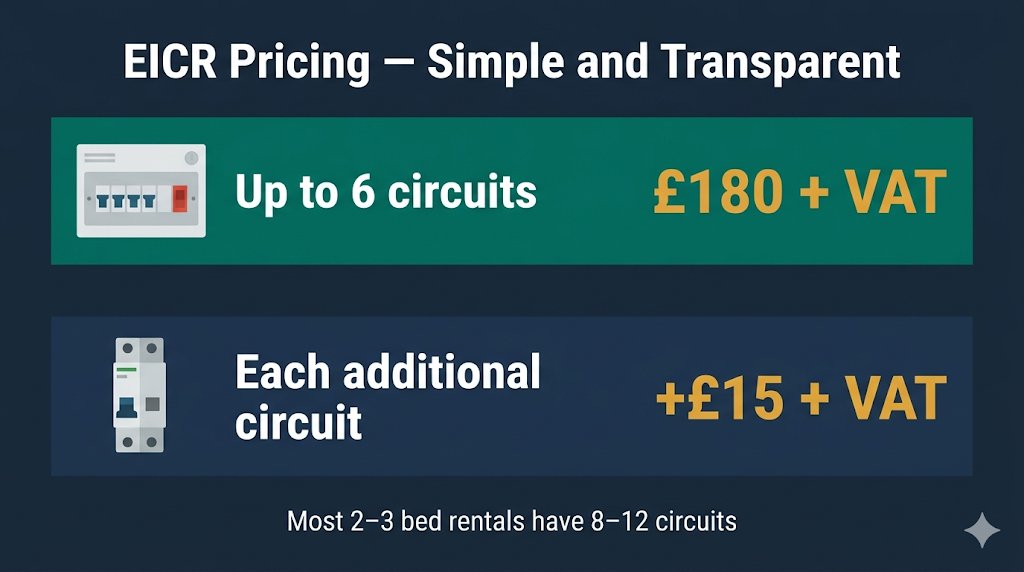
If I get to a property and find more circuits than expected, I'll tell you before I start and confirm you're happy to proceed at the adjusted price. I won't spring it on you at the end.
Why this matters if you're a landlord
You're legally required to have an EICR carried out every five years. The fine for non-compliance can now reach £40,000. But the legal requirement isn't just to have a piece of paper, it's to have the electrical installation properly assessed by a qualified and competent person.
A cheap, rushed EICR that skips circuits gives you the paperwork without the protection. If something goes wrong in an area that wasn't properly tested, the report won't protect you in the way you might expect it to.
Circuit-based pricing means I'm incentivised to count correctly and test everything. There's no margin in rushing, the price reflects the work, so the work gets done properly.
One question worth asking any electrician
If you're getting quotes for an EICR and you want a quick sense of how the job will be approached, ask: "How do you price your EICRs?"
If the answer is a flat rate by bedroom count with no mention of circuits, that tells you something about how the job is likely to be done.
You're entitled to honest pricing that reflects the actual work involved. That's what circuit-based pricing delivers, for both of us.
Frankie Sewell
NICEIC Approved Contractor • YRLA Recognised Service Provider • Bright Sparks of York