What an EV Charger Install Actually Involves
By Frankie · June 2026 · 6 min read
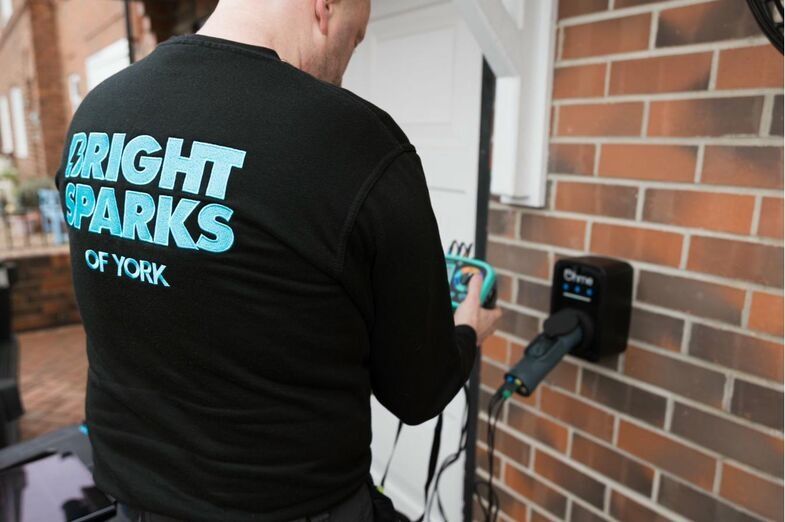
You've decided you want an EV charger on the wall, or you're close to it, and you want to know what you're actually buying before someone turns up with a drill. Good. This is the whole job, start to finish, so there are no surprises. It's more than "screw a box to the wall and run a cable", and the bits people don't see are exactly the bits that keep you safe and keep your installation legal.
First, a survey, not a guess
Before I can price the job properly, I need to look at three things, either in person or from clear photos.
The first is your consumer unit, the box with all the switches in it. I need to see whether there's room for a new circuit and what condition it's in. A charger draws a steady, heavy load for hours at a time, so it gets its own dedicated circuit, the same principle as a shower or a cooker. If you've read why some appliances need their own circuit, this is the same idea.
The second is your main supply, the big fuse where the electricity comes into the house. Most homes have either a 60A, 80A or 100A main fuse. A 7kW charger pulls around 32A on its own, and that has to share with everything else that might be running at once: the shower, the oven, the kettle. Part of the survey is working out whether your supply can comfortably take a charger, or whether we manage the load so the charger eases off when the rest of the house is busy. I'd rather find that out on a survey than halfway through the job.
The third is the practical bit: where the car parks, where the unit goes, and the cable route between the consumer unit and the wall. A tidy, sensible route is part of doing the job properly.
Telling the grid: the DNO notification
Here's one most people have never heard of. When you add a charger, you're adding a meaningful new load to the local network, so your Distribution Network Operator (the company that owns the cables in the street, not your energy supplier) has to be told.
For a standard single home charger I handle this for you. In most cases it's a "notify after" job, I install it and register it with the network within the required window. If your supply is already heavily loaded, the rules say it may need the network's approval before we connect. Either way, it's my job to sort, not yours. You'd be surprised how many cheap installs skip this step entirely. I don't.
On the day: the install and the safety devices
With the survey done and the price agreed, the install itself is usually a few hours.
I run the new dedicated circuit from your consumer unit to the charge point, mount the unit, and connect it up. The part that matters, and the part a bargain install sometimes gets wrong, is the protection.
A charger has to sit behind a 30mA RCD, the device that cuts the power in a fraction of a second if current starts leaking where it shouldn't, for example through a person. On top of that, EV charging can produce a particular kind of "smooth DC" fault that an ordinary RCD can't see, so the installation also needs protection that catches DC faults above a small threshold. Most good modern chargers build that in; where they don't, I fit a separate device that does. Think of it as a smoke alarm that's also tuned to catch a type of smoke the standard one would miss.
If your charger is outside, which most are, there's one more. There's a rare but dangerous supply fault called an "open PEN", where a shared cable in the street fails and the metal body of an outdoor charger could briefly become live. The regulations don't allow the usual house earthing to be the only thing standing between you and that fault on an outdoor unit, so I fit either an earth rod into the ground or a device that detects the fault and disconnects instantly. It's the kind of thing you never think about until you understand it, and then you'd never want it left out.
Testing, certifying, and the paperwork you keep
Once it's wired, I test it properly, the same dead and live testing I'd do on any new circuit, and only then does it go live.
Fitting a new circuit is notifiable electrical work, which means it has to be certified and registered. I'm registered to self-certify notifiable work under Part P, so I certify the work and notify Building Control for you, and you're left with an Electrical Installation Certificate (EIC) recording exactly what was done and the test results. Keep it safe. It's the document that proves the job was done to standard, and it's the one a solicitor or a future buyer may ask to see.
Building a new house? That's Part S
One quick note for anyone building or substantially renovating. Since 2022, new homes in England with parking have to be built with an EV charge point as a building-regulations requirement, that's Approved Document S. If you're just adding a charger to an existing house, Part S doesn't apply to you, it's simply the notifiable electrical work above. But if you're a builder or doing a big renovation, it's worth a conversation early, because it's cheaper designed in than bolted on.
Is there still a grant?
Sometimes, depending on who you are. The government chargepoint grant gives up to £500 per socket. The catch is who qualifies:
- Flat owners and renters with their own off-street parking can still claim it.
- Households with on-street parking can claim it, where a cross-pavement charging solution is fitted with the local council's permission.
- Landlords can claim up to £500 per socket across their rental properties.
- Homeowners with a normal driveway no longer qualify, that grant closed back in 2022.
The grant runs until 31 March 2027 and has to be claimed through an OZEV-approved installer, which I am. If you're in one of the groups that still qualifies, I'll tell you and handle it.
What it costs, and how I price it
I survey every charger install, on site or from clear photos, and give you a written estimate before any work starts. What moves the number is the cable run, whether your supply needs any work to take the load, and the charger you choose. Chargers are usually straightforward to price once I've seen those three things, so in practice my estimate is what you pay.
Now and again a house catches you out, an old supply cable or a route that turns out to be blocked once the boards come up. If that happens I stop, show you what I've found, and we agree what to do next before I carry on. You're never committed to extra cost without being asked first, and you'll never get a bill with something on it you haven't already seen.
If you're thinking about a charger, tell me roughly where your consumer unit is and where the car parks, and I'll tell you what's involved for your specific house.
Frankie Sewell
NICEIC Approved Contractor • OZEV Approved Installer • YRLA Recognised Service Provider • Bright Sparks of York