Do I Need a Dedicated Circuit? Showers, Hot Tubs, EV Chargers and Other High-Draw Loads
By Frankie · April 2026 · 8 min read

Last month I fitted a new electric shower in a 1970s semi in Acomb. The previous shower had been wired into the upstairs ring main using 2.5mm cable. It had been like that for years, but the cable was warm to the touch every time the shower ran, and the MCB was tripping more and more often. That’s the kind of thing that doesn’t announce itself until it becomes a problem. The shower needed its own dedicated circuit, and it should have had one from day one.
This comes up constantly. Someone wants a hot tub, an EV charger, a new electric shower, or an immersion heater, and the question is always the same: can I just plug it in, or does it need its own circuit? The answer, for anything that draws a serious amount of power, is almost always the same: it needs a dedicated circuit.
What Is a Dedicated Circuit?
A dedicated circuit is a cable that runs directly from your consumer unit to a single appliance and nothing else. It has its own protective device, an MCB or RCBO, at the board, and it serves only that one load. No sockets. No other connections. Just a direct run from the board to the appliance.
The reason is simple. High-draw appliances pull a lot of current, often for extended periods. If that current is sharing a cable with other things, the cable heats up, the connections degrade, and the protective device can’t do its job properly because it’s trying to manage multiple loads at once. A dedicated circuit means the cable is sized correctly for that specific load, the protective device is rated to match, and nothing else on the system is affected when the appliance runs.
Electric Showers: 8.5–10.8 kW
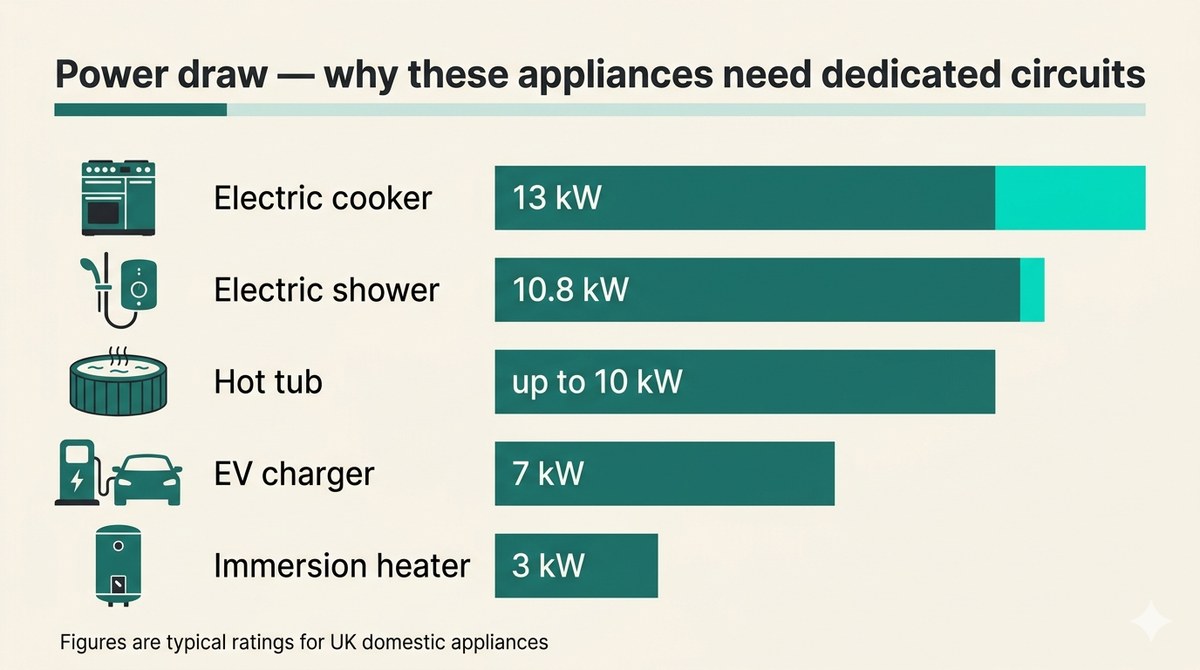
An electric shower is one of the highest-draw appliances in most homes. An 8.5 kW shower draws around 37 amps. A 10.8 kW unit draws closer to 47 amps. To put that in context, your ring main, the circuit that feeds your plug sockets, is designed for a maximum of about 32 amps shared across every socket on that floor.

An electric shower needs a dedicated radial circuit, typically run in 10mm two-core-and-earth cable from the consumer unit to a ceiling-mounted pull-cord isolator switch in the bathroom, and then down to the shower unit. The circuit is protected by a 40A or 45A MCB or RCBO at the board, depending on the shower’s kilowatt rating and the cable run length.
The pull-cord isolator isn’t optional; it’s a requirement under BS 7671. It allows the shower to be isolated without leaving the bathroom, and it keeps the switching mechanism outside the spray zone.
Hot Tubs: Outdoor Rated, RCD Protected
Hot tubs vary enormously in their electrical requirements. A small plug-in model might draw 13A from a standard socket, but most permanent installations draw between 16A and 32A, and some larger units go higher. The sustained nature of the load matters as much as the peak draw: a hot tub heater cycles on and off for hours at a time to maintain temperature.
A permanent hot tub installation needs a dedicated circuit run in steel wire armoured (SWA) cable, which is rated for outdoor and underground use. The circuit requires RCD protection at the consumer unit, and an IP-rated isolator switch must be positioned within sight of the tub but far enough away that someone standing in the water can’t reach it. BS 7671 specifies minimum distances for this.
Every connection point outdoors needs to meet a minimum IP rating for water ingress protection. This isn’t the sort of installation where a length of twin-and-earth cable through the wall will do the job. The cable, the connections, and the isolation all need to be appropriate for an outdoor wet environment.
EV Chargers: 7 kW, 32A, and a DNO Notification
A standard home EV charger draws 7 kW at 32 amps, continuously, for several hours at a time. That’s the same current as a large electric shower, but sustained for much longer. The charger needs a dedicated 10mm radial circuit from the consumer unit, protected by its own RCBO.
What makes EV charger installations different from most domestic work is the DNO notification requirement. The charge point has to be registered with the Distribution Network Operator, that’s Northern Powergrid in the York area, because adding 7 kW of continuous load to a property can affect the local supply infrastructure. Whether that registration happens before the work or after it depends on the property’s maximum demand. The DNO may impose conditions, such as requiring the charger to include load management that reduces its draw during peak periods.
This notification step is often missed by installers who treat an EV charger like just another socket circuit. It’s a regulatory requirement, and skipping it can cause problems later, particularly if the property is sold and the new owner or their solicitor asks for the installation paperwork.
Immersion Heaters: Lower Draw, Sustained Load
An immersion heater is typically rated at 3 kW, which is considerably less than a shower or EV charger. So why does it need a dedicated circuit?
Because it runs for a long time. An immersion heater cycling to maintain a hot water cylinder can draw its full 3 kW for hours on end, especially during winter or in a house without gas central heating. That sustained load generates heat in the cable and at every connection point. On a shared ring main, this continuous background draw reduces the capacity available for everything else on the circuit and gradually stresses the connections.
An immersion heater gets its own dedicated circuit, usually run in 2.5mm cable on a 16A MCB or RCBO, with a switched fused connection unit near the cylinder as the local isolation point.
Cookers and Induction Hobs: The Dedicated Circuit You Already Have
Most people don’t realise they already have a dedicated circuit in the kitchen. The cooker circuit, that thick cable running to the cooker control unit on the wall, is a dedicated radial circuit, typically 6mm cable on a 32A MCB. It’s been standard practice for decades, because an electric oven and hob together can draw 10–13 kW.
Induction hobs are particularly demanding. A four-zone induction hob can draw up to 7.4 kW on its own, and when paired with an electric oven, the combined load easily exceeds what a ring main can handle. This is why the cooker has always had its own circuit, the same principle applies to every other high-draw appliance in this article.
Why a Shared Ring Main Can’t Handle These Loads
Your standard socket ring main uses 2.5mm cable and is protected by a 32A MCB. It’s designed to serve multiple socket outlets where the load is distributed, a lamp here, a television there, a phone charger on the landing. The total load at any one time is usually well within the cable’s capacity.
But plug in something that draws 30 or 40 amps on its own and you have a fundamental mismatch. The cable overheats. The MCB trips repeatedly, or worse, it doesn’t trip quickly enough and the cable insulation starts to degrade. The connections at the socket, the junction boxes, and the consumer unit all heat up under a load they were never designed to carry.
I see this regularly during EICRs. Someone has wired a high-draw appliance into a socket circuit because it was convenient, and the signs of overheating are visible at the connections. That’s a C2 observation, potentially dangerous, and it always means running a proper dedicated circuit as part of the remedial work.
Cable sizing matters
2.5mm cable, standard ring main. Rated for about 20A in normal conditions. Fine for distributed socket loads. Not suitable for any single appliance drawing more than 13A sustained.
6mm cable, cooker circuits, some larger immersion heaters. Rated for around 32A depending on installation method and cable run length.
10mm cable, electric showers, EV chargers, large hot tubs. Rated for 40–50A depending on installation method. This is the cable size that goes behind the wall when I install a shower or charger.
When Adding a Circuit Means Upgrading the Consumer Unit
Every dedicated circuit needs its own way, its own slot, at the consumer unit. If your board is full, there is nowhere to connect the new circuit. At that point, the options are either a secondary enclosure (a small additional board next to the main one) or a full consumer unit upgrade.
In practice, if someone needs a new dedicated circuit and the board is already full, I usually recommend upgrading the consumer unit rather than adding a secondary enclosure. An older board often lacks individual RCBO protection, may not have surge protection, and may be at the end of its useful life anyway. Replacing it with a modern Hager board with individual RCBOs and an integrated SPD brings the entire installation up to current standards in one visit, and provides spare ways for any future circuits.
It’s also worth noting that adding a new circuit to an installation is notifiable work under Part P of the Building Regulations. The work needs to be carried out by a competent person, meaning a registered electrician, and it needs to be certified with an Electrical Installation Certificate (EIC). This applies whether the circuit is for a shower, a hot tub, an EV charger, or anything else.
How to Know If You Need a Dedicated Circuit
The general rule is straightforward. If an appliance draws more than 13 amps, or if it draws a sustained load for extended periods, it almost certainly needs its own dedicated circuit. The electric shower on the wall, the hot tub in the garden, the EV charger on the drive, the immersion heater in the airing cupboard, each of these gets its own cable, its own protective device, and its own route back to the board.
If you’re planning any of these installations, the first step is always a site visit. I need to see the consumer unit, check for spare ways, assess the cable route, and confirm the existing supply can handle the additional load. From there, I can give you a clear estimate for the work and explain exactly what’s involved.
Tell me what you want to achieve, I’ll work out how to get you there.
Frankie Sewell
NICEIC Approved Contractor • YRLA Recognised Service Provider • Bright Sparks of York
Need a dedicated circuit in York?
Whether it’s a shower, hot tub, EV charger, or something else, I’ll carry out a site visit, check your consumer unit, and give you a clear estimate for the work.
Questions
Does an immersion heater need a dedicated circuit?
Yes. Although an immersion heater is typically only 3 kW, much lower than a shower or hot tub, it runs for sustained periods, sometimes hours at a time. That sustained load generates heat in the cable and connections, which is why it gets its own dedicated circuit rather than sharing a ring main with other appliances.