A sub-main too small for its supply
The cable looked solid. Steel wire armour, the heavy black stuff you expect on a proper supply. It was carrying the whole house. It was also far too small for the fuse protecting it, which meant the one thing meant to keep it safe could not do its job.
The find
A licensed HMO in York, six lettings rooms over two floors. The whole property was fed from the meter to the consumer unit by a single armoured sub-main. The service fuse at the cut-out, the only overcurrent device protecting that cable, was rated at 100A. The cable itself was 16mm².
That is the problem in one line. A 16mm² cable cannot safely carry 100A. Its safe capacity is well below that figure in any installation method, and this one ran concealed through the building fabric, which lowers the capacity further still. The fuse was rated for far more current than the cable could ever carry.
What you’re looking at
A protective device, a fuse or a breaker, is there to protect the cable. Not the appliance, not the user directly. The cable. It is supposed to cut off before the cable gets hot enough to be dangerous.
For that to work, the device has to be matched to the cable. Fit a device rated higher than the cable can carry, and you have removed the protection. The cable becomes the weakest link in its own circuit. It will overheat before the fuse ever notices anything is wrong.
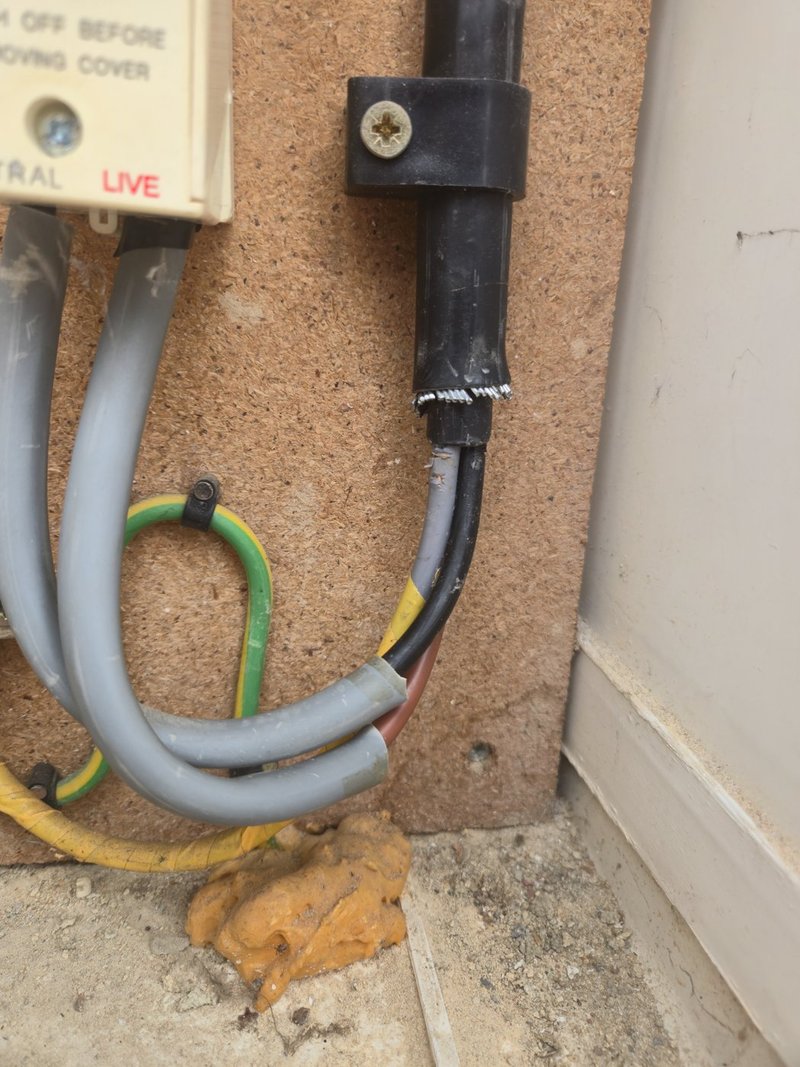
The same cable had a second problem, visible in the photo. Where it entered the main switch, the armour had no gland. It was splayed and taped over instead of being made off properly, so there was no mechanical hold and no proper earth path through the armour. One core had been re-sleeved with the salvaged sheath off an old meter tail, and a damaged section of insulation had been wrapped in tape rather than repaired. The earthing was at least on a separate green-and-yellow core rather than relying on that loose armour, which is the one thing that was right about it.
Why it matters
A fuse is a deliberate weak point. It is meant to be the thing that fails first, safely, so the cable behind it never gets the chance to overheat. Size the fuse far bigger than the cable and you move the weak point. Now the cable fails first. It just fails the dangerous way, by getting hot, instead of the safe way, by cutting off.
In a house full of tenants, all drawing power at once on a winter evening, that is exactly the load this cable was least able to handle.
The mismatch, in one picture
The fault code
C2. Potentially Dangerous. Both parts of it. The cable is not coordinated with the device protecting it, by a wide margin, and the termination offers no mechanical protection with damaged insulation left in service. Neither is an immediate “switch it off now” danger on a calm day, which is why it is a C2 and not a C1. But it is a real risk that needs putting right, not a note for the future.
The fix
Two jobs, really.
The termination gets re-made properly: a correct gland and earth arrangement, the armour made off as it should be, and the damaged core replaced so nothing compromised stays in service. The improvised sleeving comes out.
The sizing is the bigger decision. The reliable answer is to recable the sub-main in a conductor properly sized for a 100A supply, which in practice means stepping up to 25mm². There is sometimes a cheaper route, fitting a correctly sized protective device at the origin so the cable is only ever asked to carry what it can handle, but that only works if the cable’s real, derated capacity supports a sensible device rating, and a cable buried in the fabric rarely does. On this job the honest recommendation was to recable.
Armoured cable looks reassuringly heavy-duty. That look tells you nothing about whether it is big enough for the job it has been handed. The only thing that tells you is the maths, against the fuse in front of it.
Not sure your supply cable is sized for its fuse?
An EICR on a York property checks the sub-main as a matter of course. If the cable and the fuse in front of it don’t match, it’ll be on the report.
Get in Touch