Understanding Your Electrics, Part 3 of 6
MCB vs RCD vs RCBO vs AFDD: Differences Explained (2026)

Open your consumer unit and you see a row of switches, probably labelled lights
, sockets
, cooker
. Those switches do four different jobs depending on which device you are looking at. This guide walks through the four, what each one protects against, how to tell them apart on your board, and where BS 7671:2018+A4:2026 now expects each one in a modern installation.
For the separate question of which RCD type you have, see RCD types explained: AC, A, F and B.
MCB, Miniature Circuit Breaker
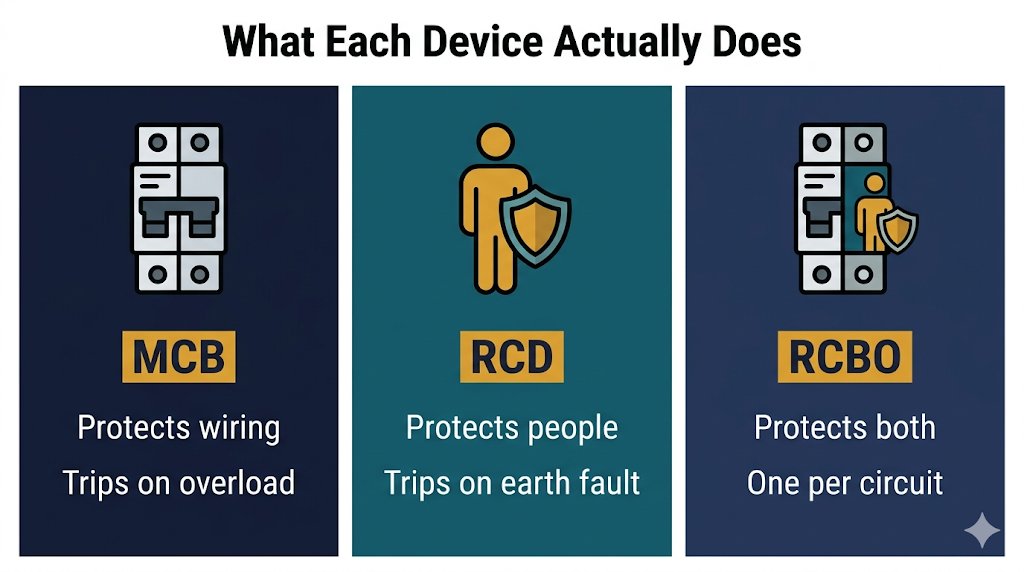
Think of an MCB as a bouncer on the door of a nightclub. Its one job is to stop too many people getting in at once. In electrical terms, if the current going through a circuit exceeds the rating of the cable (because you have plugged in too much, or because something has short-circuited), the MCB trips and disconnects the circuit before the cable overheats.
MCBs protect the wiring. They do not protect people from electric shock. A person touching a live wire typically draws far less current than an MCB needs to trip, so the MCB sits there unaware while the person goes into cardiac arrest. That is the job of the RCD.
RCD, Residual Current Device
An RCD continuously compares the current leaving the consumer unit on the live wire with the current coming back on the neutral. The two numbers should match. If they do not, current is leaking somewhere it should not, through damaged insulation, through water, or through a person. The moment the RCD sees an imbalance of 30 mA or more, it opens the circuit fast enough to prevent a fatal electric shock [2].
An RCD protects people. It does not care about overloads, that is the MCB's job. On an older board, the RCD is usually the largest device on the row, with a prominent T test button you are supposed to press every three months.
RCBO, Residual Current Breaker with Overcurrent
An RCBO does the MCB and RCD job in one device, for one circuit. The MCB side handles overload and short-circuit. The RCD side handles earth leakage. The two mechanisms are packaged into a single module the same width as an MCB, with a small T button on the front.
When something goes wrong on a circuit protected by an RCBO, only that circuit trips. Not half the house. Not a group of circuits. That single fact is why I fit an RCBO on every circuit, and RCD vs RCBO goes into it in depth [1].
AFDD, Arc Fault Detection Device
An AFDD looks a lot like an RCBO but does a different job. It watches the current waveform on a circuit for the signature of an electrical arc, a small sparking connection. Arcing happens at loose terminals, at damaged cables nipped by furniture, and at old sockets with worn contacts. Because arcing produces heat and is a leading cause of electrical fires, an AFDD disconnects the circuit as soon as the signature appears, before the arc can start a fire.
AFDDs are not a retrofit for every circuit in every property. A4:2026 requires them on final circuits supplying socket outlets rated up to 32 A in specific higher-risk dwellings: Houses in Multiple Occupation (HMOs), purpose-built student accommodation, and care homes. In other domestic premises A4:2026 recommends them but does not mandate them [1].
4-way comparison table
| Device | Protects against | Typical rating | BS / IEC standard | A4:2026 status |
|---|---|---|---|---|
| MCB | Overload, short-circuit | 6 A to 63 A | BS EN 60898 | Still allowed, paired with an RCD |
| RCD | Earth leakage, electric shock | 30 mA residual, 30 ms trip | BS EN 61008 | Minimum protection for socket and lighting circuits |
| RCBO | Overload, short-circuit, earth leakage | 6 A to 63 A, 30 mA residual | BS EN 61009 | Preferred per circuit |
| AFDD | Series and parallel arcing faults | Usually 6 A to 40 A | BS EN 62606 | Mandatory in HMOs, student and care homes; recommended elsewhere |
Type AC vs Type A vs Type B, and why it matters for EVs and solar
Not all RCDs detect the same kind of leakage. The type letter on the device tells you which waveforms it can see. Getting this wrong on an EV charger circuit is the most common expensive mistake I am asked to fix.
| Type | Detects | Typical use |
|---|---|---|
| Type AC | Alternating current residual only | Legacy boards. No longer the default for new circuits. |
| Type A | AC plus pulsating DC residual | Default minimum for most new circuits with modern electronics. |
| Type F | AC, pulsating DC and mixed frequencies | Inverter-driven appliances, some heat pumps and VSD equipment. |
| Type B | AC, pulsating DC and smooth DC | EV chargers (unless charger has built-in 6 mA DC protection), solar PV, three-phase UPS. |
If you are planning a home EV charger, the installer needs to either fit a Type B RCD on the dedicated circuit, or use an EV charger with built-in 6 mA DC residual current monitoring. Skipping this is a C2 on an EICR and a recall-level issue on a new install [3].
How to read your board, five steps
- Open the hinged coverPull open the front flap of the consumer unit. No tools. Do not touch anything behind the rocker switches.
- Read the scheduleMost boards have a printed or handwritten schedule inside the cover listing every circuit by number, function, and device rating (e.g. 6 A lighting, 32 A sockets).
- Find the main switch and any RCDsThe largest device on the left is usually the main switch. Larger switches with a T test button are RCDs. Count how many, and note which circuits each covers.
- Identify MCBs and RCBOsSingle-module devices without a T button are MCBs. Single-module devices with a small T button are RCBOs. If every circuit has a T button, you have an RCBO-per-circuit board.
- Look for AFDDsAFDDs are typically wider than MCBs and often have a status LED. They sit on specific final circuits, not every circuit. In an HMO or student property, expect to see them under A4:2026.

What BS 7671:2018+A4:2026 now requires
The 4th amendment to the 18th Edition came into force on 15 April 2026. For a domestic dwelling it is worth knowing the following headlines:
- 30 mA RCD protection on all socket outlets rated up to 32 A, and all lighting circuits
- 30 mA RCD protection on cables concealed in walls at less than 50 mm depth where not otherwise protected
- Type A as the minimum RCD type for most circuits
- Type B RCD or 6 mA DC-sensing integrated into EV charger circuits
- AFDDs on socket circuits in HMOs, purpose-built student accommodation and care homes
- Type 2 Surge Protection Device as a default expectation in most domestic premises
The cleanest way to deliver all of this on a new or replacement board is one RCBO per final circuit, the correct RCD type for that circuit, AFDDs where the property type requires them, and an SPD at the origin.
Do you need to upgrade?
Not every older board needs ripping out. A board with RCD protection that passes an EICR meets safety expectations. Four situations where an RCBO-per-circuit upgrade is worth the money:
- You have a split-load board and one side has no RCD protection. This is almost always a C2 on an EICR and is the most common single trigger for an upgrade.
- Your RCD trips and takes multiple circuits with it. An RCBO-per-circuit board isolates faults and tells you exactly where the problem is.
- You are having a new circuit installed. EV charger, heat pump, electric shower, new kitchen. The new work has to meet A4:2026, which in practice means at least RCBO protection on that circuit, and ideally the whole board brought up at the same time.
- The enclosure is plastic and the property is a flat, HMO or student house. A4:2026 wants steel and it wants AFDDs. Those two together are a full board replacement.
A note on cost
Every consumer unit job is scoped on a site visit. Circuit count, enclosure type, the state of the tails and main bonding, whether cabling needs making good, and whether Type B RCDs or AFDDs are needed all change the figure. I give you a clear written estimate before any work starts. Book a no-obligation survey.

I fit RCBO-per-circuit boards across York, from Victorian terraces in Fulford to new-build estates at Derwenthorpe. Every board leaves labelled, tested, and with the right RCD type on the EV and solar circuits. More about me.
Understanding Your Electrics, Part 3 of 6 · All parts →
Not sure what you have?
Send a photo of your consumer unit on WhatsApp and I will tell you what each device is and whether anything needs attention. No obligation.
Frequently asked questions
What is an MCB?
An MCB (Miniature Circuit Breaker) is an automatic switch that protects a circuit from overload and short-circuit currents. If too much current flows, the MCB trips and disconnects the circuit before the cable overheats. It does not protect people from electric shock.
What is an RCD?
An RCD (Residual Current Device) monitors the balance between the live and neutral currents on a circuit. If current leaks to earth (through a fault or through a person), the RCD disconnects fast enough to protect people from fatal electric shock.
What is an RCBO?
An RCBO (Residual Current Breaker with Overcurrent) combines the overcurrent protection of an MCB and the earth-fault protection of an RCD in a single device on a single circuit. When a fault happens, only that circuit trips. An RCBO on every circuit is my standard on any board I fit.
What is an AFDD?
An AFDD (Arc Fault Detection Device) detects the electrical signature of an arcing fault, the kind that happens when a loose terminal or a damaged cable starts sparking. Because arcing is a leading cause of electrical fires, AFDDs are now required on specific circuits in higher-risk dwellings under BS 7671:2018+A4:2026.
What is the difference between an MCB and an RCBO?
An MCB only protects against overload and short-circuit. An RCBO adds earth-fault (residual current) protection to the same device. The standard does not name a device, but an RCBO on every circuit is my standard for meeting it.
What is the difference between a Type AC, Type A and Type B RCD?
Type AC detects alternating current leakage only. Type A also detects pulsating DC leakage, which modern electronics and EV chargers produce. Type B also detects smooth DC leakage, required for some EV chargers and solar PV installations unless the charger has built-in DC protection. Under current regulations, Type A is the default minimum for new circuits.
Do I need to upgrade my whole consumer unit to RCBOs?
Not always. A consumer unit that has RCD protection and passes an EICR is compliant. That said, RCBO-per-circuit gives better isolation and fewer nuisance trips. If you are already having work done on your board, upgrading at the same time is sensible because the labour is the large cost.
Why does my RCD trip several circuits at once?
On a split-load board, one RCD typically covers several circuits. When any of them develops an earth fault, the RCD trips and cuts power to every circuit it covers. An RCBO-per-circuit board isolates the fault to a single circuit.
Can I mix brands of MCB and RCBO in one consumer unit?
No. The devices must be listed as compatible with the consumer unit. Each manufacturer certifies their board with their own devices, and mixing brands can invalidate the enclosure’s type-testing and its short-circuit withstand rating. Stick to the devices the board manufacturer lists in the cover schedule.
When is an AFDD required?
Under BS 7671:2018+A4:2026 AFDDs are required on final circuits supplying socket outlets rated up to 32 A in specified higher-risk premises, including HMOs, purpose-built student accommodation, and care homes. On other domestic premises their use is recommended, not mandatory.
How do I tell what devices my board has?
Open the cover and look. An MCB has no test button. An RCD is larger and has a T test button. An RCBO is the same width as an MCB but has a small T test button. An AFDD is typically two modules wide and often has an indicator LED. The cover schedule should label every device by circuit.
References
- BS 7671:2018+A4:2026, IET Wiring Regulations, 18th Edition, in force from 15 April 2026. British Standards Institution. bsigroup.com
- Electrical Safety First, guidance on Residual Current Devices and shock protection. electricalsafetyfirst.org.uk
- IET Code of Practice for Electric Vehicle Charging Equipment Installation, 5th Edition. Institution of Engineering and Technology. electrical.theiet.org
- NICEIC technical guidance on consumer unit replacement and AFDD installation. niceic.com
- BS EN 62606, General requirements for arc fault detection devices. knowledge.bsigroup.com