Understanding Your Electrics, Part 7
Bathroom Electrics — What’s Allowed, What’s Not, and Why Zones Matter
By Frankie · April 2026 · 8 min read
Last week I priced a bathroom refit in Bishopthorpe. The customer wanted downlights over the shower, a heated towel rail on a timer, and a double socket next to the mirror for hair straighteners. Two of those three are straightforward. The third isn’t allowed at all, and most people have no idea why.
Bathrooms are the most regulated space in a house when it comes to electrics. Water and electricity don’t mix, and the wiring regulations (BS 7671:2018+A4:2026) deal with that by dividing every bathroom into zones. Each zone has strict rules about what can be installed, what IP rating the fitting needs, and whether it needs a special circuit. This post explains all of it in plain English.
The zone system — how your bathroom is divided
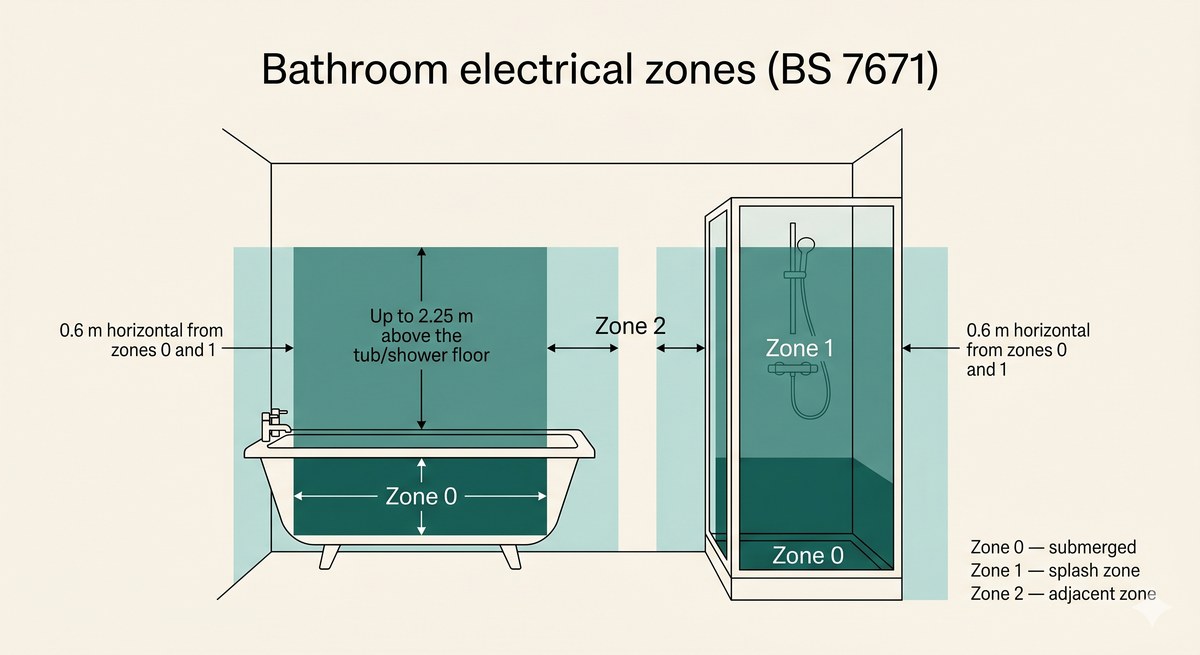
The regulations split every bathroom into four areas. Think of them as concentric rings radiating outward from where the water is.
Zone 0, inside the bath or shower tray. This is the space actually occupied by water. Only equipment specifically designed for use in this zone can go here, and it must be SELV (Separated Extra-Low Voltage, maximum 12V) and rated to at least IPX7. In practice, the only thing you’ll typically see installed here is an in-bath whirlpool motor or a chromotherapy light. Virtually nothing else qualifies.
Zone 1, directly above the bath or shower tray, up to 2.25 metres from the floor. This is where water splashes and steam concentrate. Equipment here must be at least IPX4 rated (protected against splashing from all directions). You can install SELV equipment, an instantaneous water heater (electric shower), or a whirlpool unit. Standard light fittings are not allowed unless they carry the right IP rating. Switches are not permitted in this zone.
Zone 2, extending 0.6 metres beyond Zone 1 horizontally, and up to 2.25 metres from the floor. This is the “splash zone” beyond the bath or shower. Equipment here also needs at least IPX4. You can install luminaires (light fittings), shaver supply units, fans, and other fixed equipment, provided they carry the correct IP rating.
Outside the zones, everything beyond Zone 2. In a large bathroom, this might include the area around the door or a far wall. Standard fittings without specific IP ratings can be used here, though IPX4 is still sensible practice given the general humidity. Shaver supply units are permitted. Standard 13A sockets are still not recommended inside a room containing a bath or shower, regardless of zone. This is a point most people don’t realise.
IP ratings — what the numbers actually mean
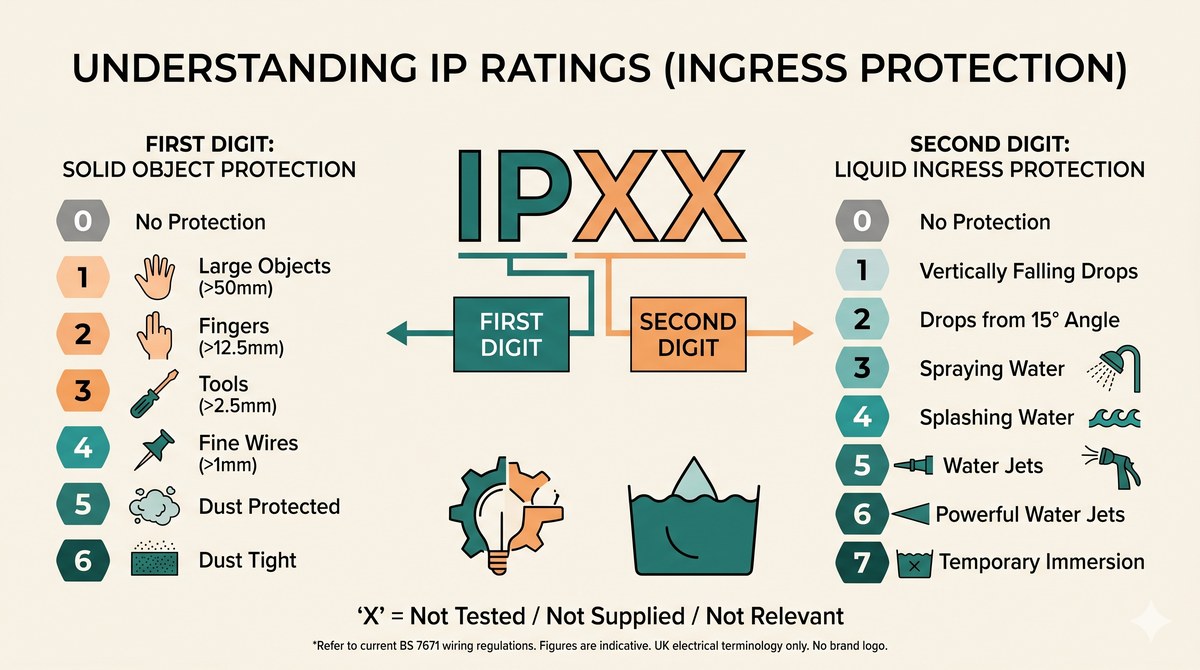
You’ll see IP ratings on the packaging of any fitting designed for bathroom use. The code is always “IP” followed by two digits. The first digit is protection against solid objects (dust). The second digit is protection against water. For bathrooms, it’s the second digit that matters most.
Common IP ratings for bathroom fittings
IPX4, protected against splashing from all directions. The minimum requirement for Zone 1 and Zone 2. This covers most bathroom downlights and extractor fans.
IPX5, protected against water jets. Required where water jets might be used for cleaning (more common in commercial settings than domestic bathrooms).
IPX7, protected against temporary immersion. Required for anything installed in Zone 0 (inside the bath or shower tray).
IP65, dust-tight and protected against water jets. A common rating for high-quality bathroom downlights. The “6” means fully dust-sealed, and the “5” means protected against jets from any direction. Well above the minimum requirement for most bathroom zones.
When I specify fittings for a bathroom job, I always recommend going at least one step above the minimum. An IP65 downlight costs a couple of pounds more than an IPX4, lasts longer in a humid environment, and means you’re not relying on the absolute minimum standard.
Pull-cord switches — why you can’t have a normal switch
This is the question I get asked most often. “Why can’t I just have a normal light switch inside the bathroom?”
A standard plate switch has exposed metal, the screws on the faceplate, the rocker mechanism. If you touch that with wet hands while standing on a wet floor, and there’s a fault, you become the path to earth. A pull-cord ceiling switch removes that risk: there’s no exposed metalwork within reach.
The alternative is to put a standard plate switch outside the bathroom door. That’s perfectly compliant and increasingly common in modern builds. But inside the room, it’s pull-cord or nothing.
Shaver sockets — the exception that confuses everyone
People see a shaver socket in a bathroom and assume that means other sockets are fine too. They’re not, and the reason comes down to how a shaver socket works.
A compliant shaver supply unit (to BS EN 61558-2-5) contains an isolating transformer. This means the output side has no connection to earth. If you touched both terminals simultaneously while standing in a puddle, the current has no path through you to earth, the transformer isolates you from the mains supply completely. That’s why they’re allowed in Zone 2 and outside zones.
A standard 13A socket doesn’t have this isolation. The neutral is referenced to earth at the consumer unit. Touch a live terminal in a wet environment and you complete the circuit through yourself. That’s why they’re banned from rooms containing a bath or shower, regardless of which zone they’d be in.
Extractor fans — when you need an electrician
A bathroom extractor fan is a fixed electrical installation. Installing one means running a new cable from the consumer unit (or connecting to an existing lighting circuit), fitting a fan with the correct IP rating for its zone, and often wiring it through an isolator switch. This is notifiable work under Part P of the Building Regulations.
I see a lot of fans that have been connected incorrectly, wired to the lighting circuit without proper isolation, or fitted in Zone 1 with an IPX2 rated unit that’s not designed for that position. The fan still works, but it’s not compliant, and it’s a common reason for RCD trips in humid weather. Moisture gets into a fitting that wasn’t designed for it, the RCD detects the leakage current, and the circuit drops.
If your bathroom fan keeps tripping the circuit, especially in winter when condensation is worst, it’s worth having the installation checked. The fan itself might be fine; it could just be the wrong rating for where it’s been fitted. I can usually diagnose this on a fault-finding visit without needing to replace anything.
Electric showers — why they need a dedicated circuit
An electric shower is one of the highest-draw appliances in a house. A typical unit draws between 8.5kW and 10.8kW, that’s more than your oven. It needs its own dedicated circuit from the consumer unit, with cable sized to handle the load (usually 10mm² twin and earth for a 9.5kW shower), its own RCBO or MCB at the board, and a double-pole isolator switch within reach of the shower but outside the zones.
I occasionally see showers that have been connected to a ring main or wired with cable that’s too thin for the rated load. The shower works for a while, but the cable runs warm. Over time, the insulation degrades and the connection at the switch can overheat. It’s one of the more dangerous things I find during EICRs on older properties, and it is worth reading what an EICR checks and how the codes work if you have one coming up.
If you’re having a new electric shower installed, I’ll run a dedicated circuit from the consumer unit, sized correctly for the specific unit, with a new RCBO on the board. If the existing board has no spare way or no RCD protection, that is the point where a consumer unit upgrade comes into the conversation. It’s the kind of job where doing it properly first time means you never have to think about it again.
Heated towel rails — not as simple as plugging in
Electric heated towel rails need their own fused spur. They draw a steady load whenever they’re on, and connecting one to a standard socket circuit creates exactly the kind of persistent load those circuits aren’t designed for. A fused connection unit with a 3A fuse, wired as a spur from a ring main or radial circuit, is the correct method.
The towel rail itself also needs the right IP rating for its position. If it’s within Zone 2, it must be rated to at least IPX4. The fused connection unit should be mounted outside Zone 2 where possible, or at minimum outside Zone 1.
If you’re having a bathroom refitted and want a heated towel rail, this is one of those things worth planning into the first fix rather than trying to add afterwards. Running the spur cable is straightforward when the walls are open; it’s considerably more disruptive once everything is tiled.
Part P — bathroom work is notifiable
This is the critical point that ties everything together. Under Part P of the Building Regulations, any new circuit in a bathroom, or any alteration to an existing circuit within a room containing a bath or shower, is notifiable work. That means it must be designed, installed, and tested by a competent person, and notified to your local Building Control.
I’m registered to self-certify notifiable work under Part P, so the notification is handled as part of the job. I certify the work and the notification goes to Building Control automatically. You receive a certificate confirming the work is compliant, the document a solicitor will want to see if you ever sell the property.
If the work isn’t notified, you won’t have that certificate. When you come to sell, you’ll either need to apply for retrospective Building Control approval (which means paying for an inspection and potentially remedial work) or accept that it will be flagged during the buyer’s survey. Either way, it costs more than getting it done right in the first place.
For more on what counts as notifiable and what doesn’t, I’ve covered this in detail in the post on DIY vs professional electrical work.
What I’d recommend
If you’re planning any electrical work in a bathroom, whether it’s a full refit, new lighting, a shower replacement, or just adding an extractor fan, get an electrician involved at the planning stage. Not because I’m trying to create work, but because the zone restrictions and IP requirements affect where things can physically go. It’s much easier to plan around those constraints before your tiler starts than to discover them afterwards.
If you’re working with a bathroom fitter or a builder, I’m happy to coordinate with them on first fix. I’ll do the cable runs and back-box positions while the walls are accessible, then come back for second fix once the tiling is done. That’s how it should work, and it’s how I handle most bathroom jobs in York.
If you want to talk through what’s involved for your bathroom, send me a message on WhatsApp or give me a ring. Tell me what you want to achieve, I’ll work out how to get you there.
Frankie Sewell
NICEIC Approved Contractor • YRLA Recognised Service Provider • Bright Sparks of York
Questions
Can I have a normal light switch in the bathroom?
A standard plate switch is not permitted inside a bathroom. Pull-cord switches are the accepted solution because there is no exposed metalwork for you to touch with wet hands. The switch can be a standard plate type if it is mounted outside the bathroom door.
Is bathroom electrical work notifiable under Part P?
A new circuit is notifiable wherever it is, so a new circuit in a bathroom is. An alteration to an existing circuit is notifiable only inside the zone around the bath or shower, which is measured 2.25 metres up from the floor and 0.6 metres out from the edge of the bath or shower tray. Outside that zone it is not notifiable, and neither is replacing an accessory like for like. Where the work is notifiable I certify it myself and send the notification, so you do not need to contact building control.
Do I need an electrician to fit a bathroom extractor fan?
Usually, and the notification depends on the circuit. A fan on a new circuit is notifiable. A fan wired into an existing circuit is notifiable if the work is inside the zone around the bath or shower, and not if it sits outside that zone. Either way the fan has to suit its position and the circuit has to be right for it, which is the part worth having done properly. Where it is notifiable I certify and notify it myself.
Understanding Your Electrics, Part 7