Understanding Your Electrics, Part 4 of 6
How Do I Know If My Wiring Needs Replacing?
By Frankie · March 2026 · 5 min read
Nobody wakes up thinking "I need a rewire." You notice something, a light that flickers, a socket that feels warm, a faint burning smell you can't pin down. Or you're buying a house and someone mentions the wiring might be original. This post helps you work out what you're actually dealing with.
What you can check yourself
Look at your sockets and switches. Round-pin sockets are a reliable indicator of pre-1960s wiring, the kind that almost certainly needs attention. Yellowed or discoloured faceplates, scorch marks around sockets, or covers that feel warm to the touch are all worth taking seriously.
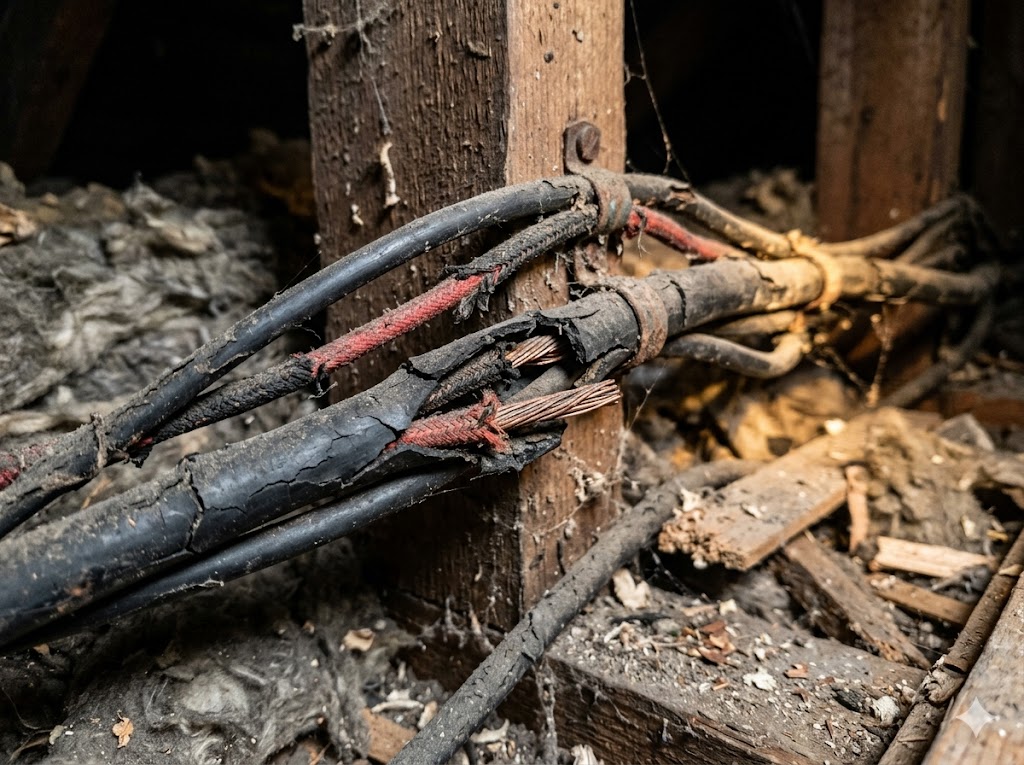
Look in your loft and at the consumer unit. If you can see cables in the loft, look at the outer sheathing. Rubber-insulated cable (black or sometimes red outer covering, very stiff or brittle) dates from before the 1960s. Fabric-covered cable is similarly old. If it crumbles when you touch it, it's well past its safe working life. Modern cable has a smooth grey or white PVC outer sheath and is flexible.
Pay attention to behaviour. Lights that dim or flicker, and it's not the bulb, can indicate a loose connection or a circuit that's struggling. A circuit breaker that trips repeatedly isn't just annoying; it's telling you something. A burning smell with no obvious source is never something to ignore.
Age as a rough guide — and why it's not the whole story
Think of your wiring like the plumbing in an old house. Age matters, but so does how it's been treated, whether it's been added to over the years, and whether anyone's looked at it recently.
Pre-1960s: Rubber-insulated wiring. If it hasn't been replaced, it almost certainly needs to be. Rubber degrades over decades and the insulation becomes unsafe.
1960s–1970s: Early PVC wiring. Better than rubber, but often laid without proper earthing to modern standards. Sockets from this era are typically only two-pin (no earth). This doesn't automatically mean a full rewire, but it does mean your earthing is likely inadequate for modern appliances.
1980s–1990s: Generally PVC-insulated and in reasonable condition, but consumer units from this era often lack RCD protection. The wiring itself may be fine; it's the protection device (the board) that usually needs upgrading first.
Post-2000: Likely to be in good condition, but age alone doesn't guarantee it. Poor DIY work at any point can introduce problems regardless of when the original installation was done.
What I typically find in York properties
York has a huge range of housing stock, and the electrical picture varies a lot by area and era.
In the 1930s terraces around Holgate, Leeman Road, and Tang Hall, I regularly find properties with original rubber-insulated wiring that's been extended and patched over the decades rather than replaced. These need a full rewire, there's no safe way to keep adding to wiring that's already past its safe life.
In the 1960s and 70s semis on estates like Woodthorpe, Acomb, and Rawcliffe, the wiring is usually PVC and often still serviceable, but the earthing is typically inadequate and the consumer unit will be due an upgrade. Often this is a staged job: upgrade the board first, add earthing improvements, rewire the worst sections if needed.
In the newer detacheds and estates built from the 1990s onwards, places like Huntington, Skelton, and the villages north of York, the wiring is usually fine. What I more commonly find is a consumer unit that's getting old, or circuits that have been added by previous owners without proper certificates.
“Monitor and plan” versus “get this looked at now”
Not everything that's old needs immediate action. But some things do. Here's the honest version:
Get it looked at now if: you can see rubber or fabric-covered cable, you have scorch marks or a burning smell, you have no RCD protection (a fuse box with no switches, just fuse holders), or any circuit is tripping repeatedly.
Monitor and plan if: you have an older but functioning consumer unit with RCD protection, the wiring is PVC but from the 1970s–80s with no obvious symptoms, or you're planning work on the property in the next year or two anyway, worth factoring an upgrade into that rather than doing two separate jobs.
One thing I always say
A full rewire isn't always the answer, and I won't tell you that you need one if you don't. Sometimes a consumer unit upgrade, additional earthing, or a partial rewire of the worst sections is genuinely enough. The right starting point is an EICR, it'll tell you exactly where things stand without guesswork. I'll explain what that involves in Part 5 of this series.
If you're not sure whether what you've seen falls into "now" or "later", send me a photo on WhatsApp. I'll give you a straight answer.
Frankie Sewell
NICEIC Approved Contractor • YRLA Recognised Service Provider • Bright Sparks of York
Questions
What are the warning signs that wiring needs attention?
Key signs include: flickering or dimming lights that aren't the bulb, scorch marks or discolouration around sockets or switches, a burning smell with no obvious cause, circuits that trip regularly, old round-pin sockets, and rubber or fabric-covered cables visible in the loft or at the consumer unit.
Understanding Your Electrics, Part 4 of 6